








“Al HaNissim” (for the miracles)
The days of Hanukkah are defined as “Days of Praise and Gratitude” to the Creator of the world for the miracles and wonders He performed for us and our ancestors. We do not say the “Tachanun” section during all eight days of Hanukkah during the Shacharit and Mincha prayers, and on these days our ‘regular’ prayer order changes slightly, as follows:
In all the “Amidah” prayers of Shacharit, Mincha, and Ma’ariv (during the “Modim” blessing), and also in the “Birkat HaMazon” (after the “Nodeh Lecha” blessing), we add a special section for Hanukkah that begins with the words: “Al HaNissim”.
In the “Al HaNissim” prayer, we recall the miracle of Hanukkah that occurred “in the days of Mattityahu son of Yochanan the High Priest,” and we thank the Creator of the world for standing by our side in times of trouble, causing “the mighty to fall into the hands of the weak, and the many into the hands of the few.”
Shacharit Prayer
On all eight days of Hanukkah, we pray the Shacharit prayer – up to after the “Amidah” – as usual, like on any weekday.
After the conclusion of the “Chazarat HaShatz” of Shacharit, we say the “Full Hallel” with a blessing before it. The cantor says “Half Kaddish”, and one Torah scroll is taken out of the Ark. Three men are called up for the Torah reading, as on Mondays and Thursdays, and we read from the Torah the portion “Chanukat HaMizbeach” (Numbers 7:1–8:4) from the book of “Bamidbar” (Numbers) which details the gifts and sacrifices brought by the twelve tribal leaders of the people of Israel in honor of the completion of the building of the “Mishkan” (Tabernacle) in the desert.
On Hanukkah, we read the portion “Chanukat HaMizbeach” because the work of the Tabernacle in the Sinai desert was completed exactly on the 25th of Kislev. Each day there is a special reading for that day, and it appears at the end of the siddur (prayer book).
After the reading, the cantor says “Half Kaddish”, the Torah scroll is lifted, and then we continue with “Ashrei” and “Uva Letzion”. The cantor says “Full Kaddish” and the Torah scroll is returned to the Ark while saying “Yehalelu”. After that, we continue the conclusion of the prayer as usual.
When Rosh Chodesh Tevet falls on one of the weekdays of Hanukkah, the prayer order is as follows:
After the conclusion of the “Chazarat HaShatz” of Shacharit, we say the “Full Hallel” with a blessing before it. Then we add the verses “VeAvraham Zaken”, and the cantor says “Full Kaddish”. After “Shir Shel Yom” we say “Barekhi Nafshi”, a mourner or an orphan says “Orphan’s Kaddish”, and two Torah scrolls are taken out of the Ark:
For the first scroll, three men are called up and we read the Rosh Chodesh portion. After that, we lift and roll the first scroll, and a fourth man is called up for the second scroll, in which we read the daily Hanukkah reading.
The cantor says “Half Kaddish”, the second scroll is lifted and rolled, and we continue with the recitation of “Ashrei” and “Uva Letzion”. We return the Torah scrolls to the Ark while saying “Yehalelu”, take off the tefillin of Rashi, put on the tefillin of Rabbeinu Tam, and say…
Mincha Prayer
- During the Hanukkah holiday, early Mincha prayers are held in synagogues so that we can light the candles on time.
The Mincha prayer is recited as usual, but without saying “Tachanun” (penitential prayers).
Don’t forget to add the passage “Ve’al Hanissim” (And for the miracles) in the Amidah prayer after the “Modim” (Thanksgiving) blessing.
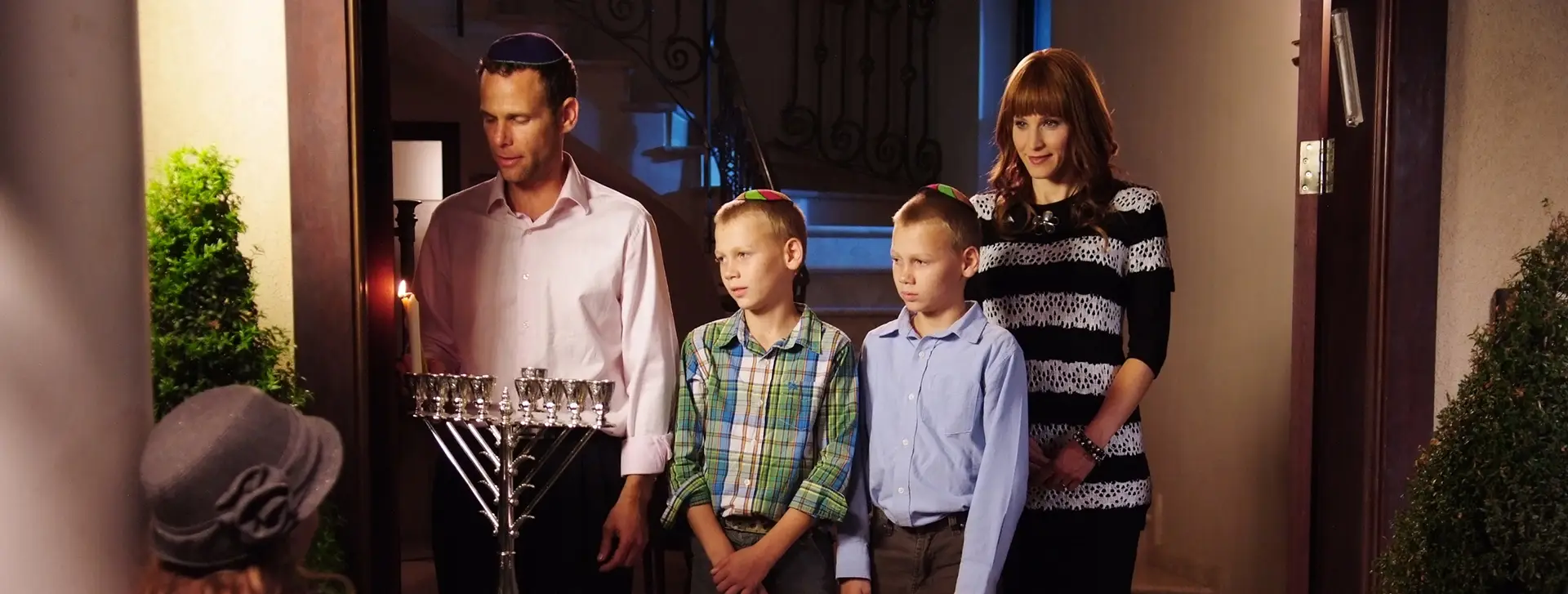
Before the “Aleinu Leshabeach” prayer, one of the worshipers lights the Hanukkah candles in the synagogue with a blessing, and the entire congregation sings together “Haneirot Halalu” (These Candles).
Then the prayer concludes with “Aleinu Leshabeach.”


