








Honoring and Enjoying Shabbat
We will now discuss in detail how to prepare for Shabbat: what to do on Friday before Shabbat begins, how to prepare the house for Shabbat, and other subjects.
Kavod Shabbat and Oneg Shabbat—Honoring and Enjoying Shabbat
The prophet Isaiah declares (Isaiah 58:13), “You shall call the Sabbath ‘a delight,’ and the holy of the Lord ‘honored.’” This verse introduces two requirements of Shabbat: to honor it and to delight in it. It is important for us to recognize and if we honor Shabbat and delight in its observance, that will be a source of both honor and pleasure for us as well.
When we engage in the preparations for Shabbat—cleaning our homes, laundering our clothes, bathing in hot water, and setting the table—we are considered to be bringing honor to Shabbat. When we prepare lavish meals for Shabbat, take a restful Shabbat nap, and the like, we are considered to be engaging in Oneg Shabbat—“enjoyment” of Shabbat.
Everybody Helps Out!
Every Friday, we begin to prepare for the arrival of Shabbat. Because Shabbat is an honored “guest,” we prepare our homes in its honor exactly as we would do if we were expecting the arrival of a dignified person.
It is considered a great mitzvah to participate in the preparations for Shabbat. Even in a household where there are many children or where there is ample household help, every member of the household should play a role, even a small one, in the preparations for Shabbat.
The Talmud describes how the Sages of old used to prepare for Shabbat. They were pious, holy men who never took an interest in materials matters such as food and the like, but every week before Shabbat, they entered the kitchen and took it upon themselves to be personally involved in the food preparation. They peeled vegetables, cleaned the heads of chickens and cows, salted fish, and engaged in other strikingly mundane activities, all out of love for Shabbat and a desire to honor it.
Purchasing Food for Shabbat
The most ideal time to purchase food for Shabbat is Friday morning, when one can sense the imminent arrival of Shabbat and truly feel that the purchases are in its honor.
If it is necessary to buy foods that require cooking or other forms of extensive preparation, they may be purchased on Wednesday or Thursday. When the purchases are made, it is a good idea to verbalize the fact that the foods are being bought in honor of Shabbat. (It isn’t even so terrible if other people overhear.)
Shopping List
It is always desirable to prepare extra food for Shabbat, beyond the basic requirements. Different types of salads, hot side dishes, desserts, sweet drinks and the like all enhance the Shabbat experience and are fitting additions to the standard Shabbat table. Many people follow the customs of their parents or communities in this respect. The following is a basic list of food items that must appear on every Shabbat table:
- A minimum of four challot—one for each meal and an additional one to serve as Lechem Mishneh.
- A bottle of wine containing a sufficient quantity of wine to make Kiddush twice and Havdalah once. Altogether, you will need three cups of wine (about 260 ml)
- Fish (of any type)
- Poultry or meat
Every year on Rosh Hashanah, G-d allots each of us a specific amount of funds for all of our expenses for the coming year: food, clothing, tuition, business expenses, and so forth. There is only one thing that is not included in this figure: the amount of money we will spend in honor of Shabbat throughout the year. The funds available to us for our Shabbat expenses are not subject to any predetermined limit. Consequently, even a person who does not have cash available right away to spend on food for Shabbat should borrow money, even if it means that he must put up some of his possessions as collateral, in order to pay for the Shabbat meals. (This pertains only to a person who knows that he will soon receive money and will have the ability to repay his debts.) With regard to such a situation, our Sages of blessed memory tell us, “G-d says to the Jewish people, ‘Borrow on Me and I will pay it back.’”
Always keep in mind that every penny that you spend in honor of Shabbat will return to you sooner or later, and sometimes you will even benefit from additional remuneration. It is worth your while to give it a try!
Special Foods
In addition to the basic foods listed above, there are a number of specific foods that have become standard Shabbat fare in Jewish culture due to their close connection with the laws of Shabbat.
Gefilte Fish
Gefilte fish (Yiddish for “stuffed fish”) is a loaf made of ground fish (generally carp) that is traditionally served along with fish brine, horseradish, carrots, and other items. This dish is particularly common in Ashkenazic communities.
The custom to eat gefilte fish is rooted in the prohibition of Borer, “selecting,” which makes it particularly difficult to eat fish that contains bones on Shabbat due to the prohibition of removing unwanted matter (in this case, the bones). Since it is proper to eat fish on Shabbat, Jewish communities devised an original solution to enable them to eat fish without struggling with the need to remove the bones. Gefilte fish is made of fish that is ground together with its bones, thereby solving—or, rather, avoiding—the problem presented by Borer.
Cholent
Cholent (known in Talmudic parlance as chamin, the plural of the word cham, “hot”) is a stew consisting of an assortment of foods (such as potatoes, sweet potatoes, meat, beans, and other foods; the ingredients vary between communities) cooked for many hours on a low flame. The process by which cholent is cooked gives the food a unique taste.
The custom of preparing cholent for Shabbat developed due to two conflicting imperatives. On the one hand, the requirement of Oneg Shabbat calls for hot food to be served at the meal on Shabbat day, but on the other hand, it is prohibited to kindle a fire or cook food on Shabbat. Cholent is the solution that satisfies both requirements. It can be placed on a fire before Shabbat begins, but even after cooking for many hours, it still serves as a filling and enjoyable dish to be consumed at the daytime meal.
Many people prepare the cholent on Friday and place it on a hot plate before Shabbat begins, once it is sufficiently cooked. The cholent remains on the hot plate throughout the night until it is served at the daytime meal.
Challah for Shabbat
Did you ever wonder why the special bread served on Shabbat is known as “challah”?
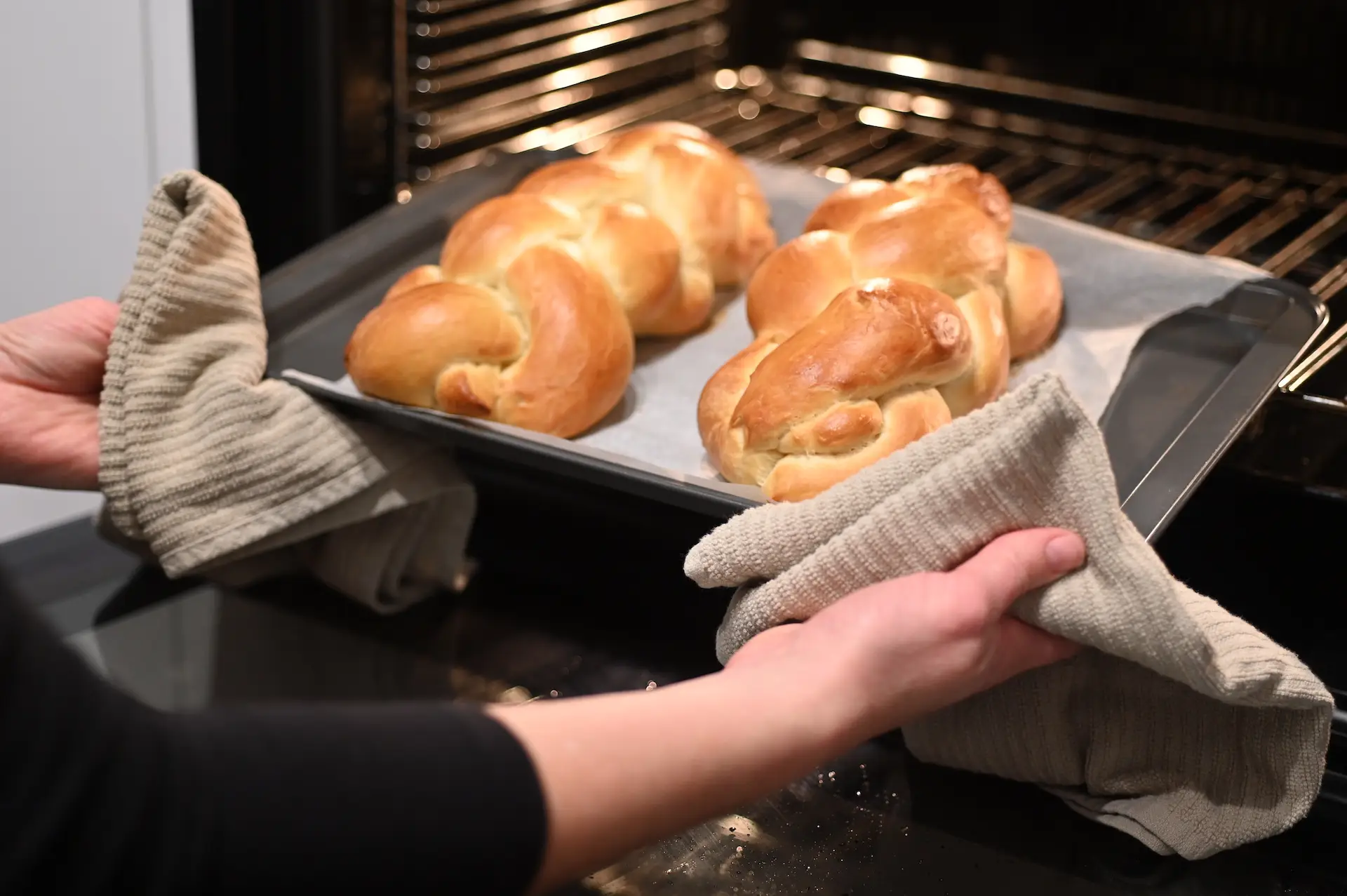
This term came into use due to the fact that we generally purchase bread from a bakery during the week, but many women bake their own bread for Shabbat. Part of the process of preparing bread involves the fulfillment of a mitzvah known as Hafrashat Challah, separating “challah.” It is customary to refer to the bread served on Shabbat as “challah” in order to remind housewives of the special mitzvah associated with its production.
Even in today’s “instant generation,” when people are used to having everything they want automatically at their disposal, it is still both possible and desirable to bake challah for Shabbat rather than purchasing it from a store. Homemade challah has many advantages over the store-bought variety. First of all, baking challah affords us an opportunity to perform the mitzvah of separating challah, which is a mitzvah that we do not encounter every day. Secondly, it is also a fulfillment of the mitzvah of preparing for Shabbat. Thirdly, of course, homemade challah is simply much tastier than its commercial counterpart!
The Mitzvah of Separating Challah
Any baked item made of one of the five species of grain (wheat, barley, oat, rye, or spelt) and containing a quantity of at least 1.666 kilograms = about 3.6 pounds of flour is subject to the requirement of Hafrashat Challah, which is accompanied by the recitation of a special blessing.
During the era of the Holy Temple, a portion of the dough was removed and given to a Kohen.
Nowadays, the mitzvah is performed slightly differently. A piece of the dough (weighing approximately 28 grams = about 1 oz.) is removed, and the blessing, “Blessed is He … Who sanctified us with His commandments and commanded us about the separation of challah,” is recited. The piece of dough that was designated to serve as challah is then burned. Some women have the custom of reciting a special prayer after they separate challah.
A detailed description of this special mitzvah, which is typically performed by women, will appear in Separating Challah—Jewish Woman.


