














Showering and Attending to Bodily Needs
Judaism does not allow us to be “holy” only within the confines of the synagogue. Jewish law has something to say even about the way we conduct ourselves at home, and even about what we do while bathing and attending to our physical needs.
-
- After arising in the morning, a person should relieve himself and make sure that his body is empty of the waste that accumulated within it over the course of the night.
- The classic works of Jewish law contain specific guidelines regarding how to conduct oneself in the bathroom. In general terms, one must adhere to the rules of modesty.
- The teeth should be brushed or the mouth rinsed, since we are about to use our mouths to recite blessings and prayers before G-d.
- In the shower, the head should be washed before the rest of the body. When washing the hands or feet, one should wash the right hand or foot first.
Just as Judaism accords a place of honor to the right side, it also calls for us to treat the head with particular respect. The head is located at the highest point on the body, and it is also the most important part of the body, since it contains the brain, as well as the organs that we use to see, hear, smell, and taste.
Cutting Nails
There is a specific procedure for cutting one’s nails as well, regardless of whether this is done during the day or at night.
-
- One should begin with the right hand and cut the nails on the fingers in the following order: first the index finger, then the ring finger, then the thumb, then the middle finger, and finally the little finger.
- One should then continue with the left hand, in the following order: the ring finger, the index finger, the little finger, the middle finger, and the thumb.
-
- This order applies only to the fingernails. There is no specific order for the cutting of toenails.
- It is customary to refrain from cutting one’s nails on a Thursday.
- It is customary to refrain from cutting one’s fingernails and toenails on the same day.
- The nails should not be allowed to fall on the floor. They should be flushed down the toilet instead.
Covering the Head
Every Jewish male is required to cover his head throughout the day. This covering can be a hat, a kippah, or any other form of head covering. Keeping our heads covered reminds us that there is always Someone above us—G-d—and this awareness has a direct impact on the way we conduct ourselves throughout the day.
-
- One should not walk without a covering on one’s head. One’s head should not be bare even while one is sitting still.
- It is highly recommended to wear a head covering even while sleeping.
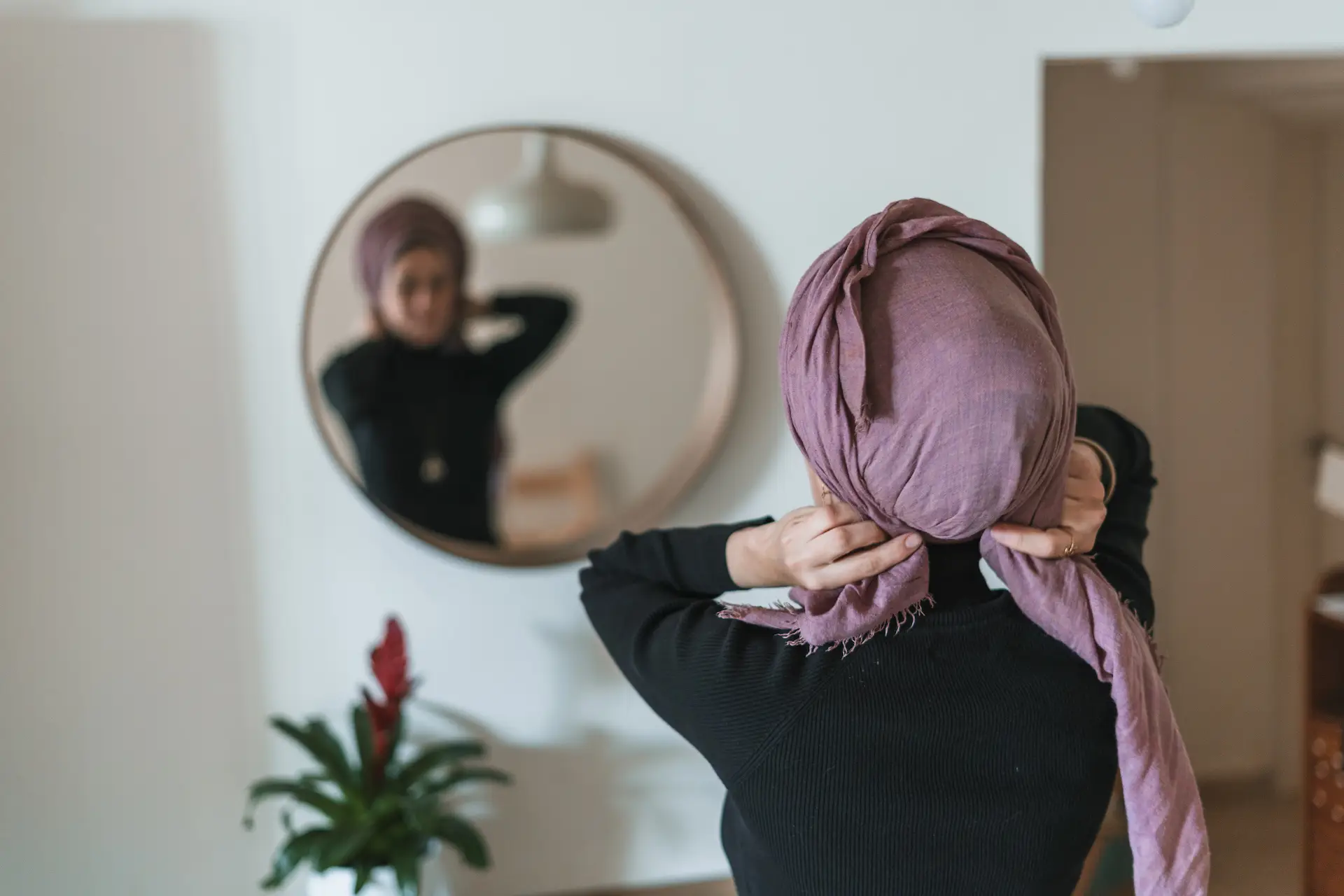
The obligation for women to cover their hair applies only once they are married. Young girls or unmarried women are not required to cover their Hair.
A detailed discussion of the laws of head covering for a woman can be found in Your Jewish Guide—The Life of a Jewish Woman.
Modesty
Though getting dressed is one of the most trivial acts we do daily, there are a number of important rules on the subject that we must keep in mind.
The concept of modesty occupies a place of great importance in the Jewish religion. A person should develop a mode of conduct that is in keeping with the principle of modesty.
We must remain modest even while we are in our personal bedrooms, even when there is no one else in the room and it is dark. One of the most basic ideas of Judaism is that we have faith that G-d is always with us, at all times and wherever we are. He sees us and is with us at every moment of the day, even after we have turned out the lights.
Beyond the fact that we must always conduct ourselves with modesty since G-d is always watching us, acting this way will also cultivate the trait of humility, along with other noble characteristics. The benefit, then, is all ours.
Getting Dressed
- When disrobing in the bedroom, one should do so in such a way that the parts of one’s body that are generally covered will not be exposed. Thus, one should undress and dress under a blanket or other covering.
Donning each article of clothing separately
-
- One should not put on two different garments (such as an undershirt and a shirt, or a shirt and a sweater) at the same time.
- One should also not remove two garments together.
Wearing each garment correctly
- One should be careful not to put on any item of clothing inside out, with the stitches showing.
Right side first
-
- As we have mentioned, one should always begin with the right side; this rule applies to the procedure for getting dressed, as well. For instance, when putting on a shirt, one should place one’s right arm in the shirt before the left arm. The right leg should also be the first leg placed in a pair of pants.
- In contrast to this, when taking clothing off, one should take off the left side first and then the right side.
Shoes
-
- With regard to shoes, as well, the right shoe should be placed on the foot before the left shoe. With respect to tying the shoes, however, the order is reversed, and one should tie the left shoe first and the right shoe only after that.
- The left shoe should be removed before the right shoe.
Even though the Torah calls for the right to come first in almost every situation, it instructs us to wear tefillin specifically on our left arms. We learn from this that whenever we must tie something, the left hand takes precedence over the right hand, just as the tefillin are tied on the left hand. Therefore, when we tie our shoelaces, the left shoe comes before the right.
Dressing Respectably
Judaism gives us guidelines not only for the order in which we put on our clothes, but also for the type of clothes that we wear. The Jewish religion always teaches us to opt for the “middle ground.” This means that one should refrain from buying clothes that are particularly expensive and upscale (the type of clothes that are far beyond the accepted norm), even if we have enough money to afford such attire, in order to prevent us from growing haughty.
At the same time, we should not wear clothes that are cheap-looking or soiled, since they would cause others to disparage us.


