












Shalom Aleichem
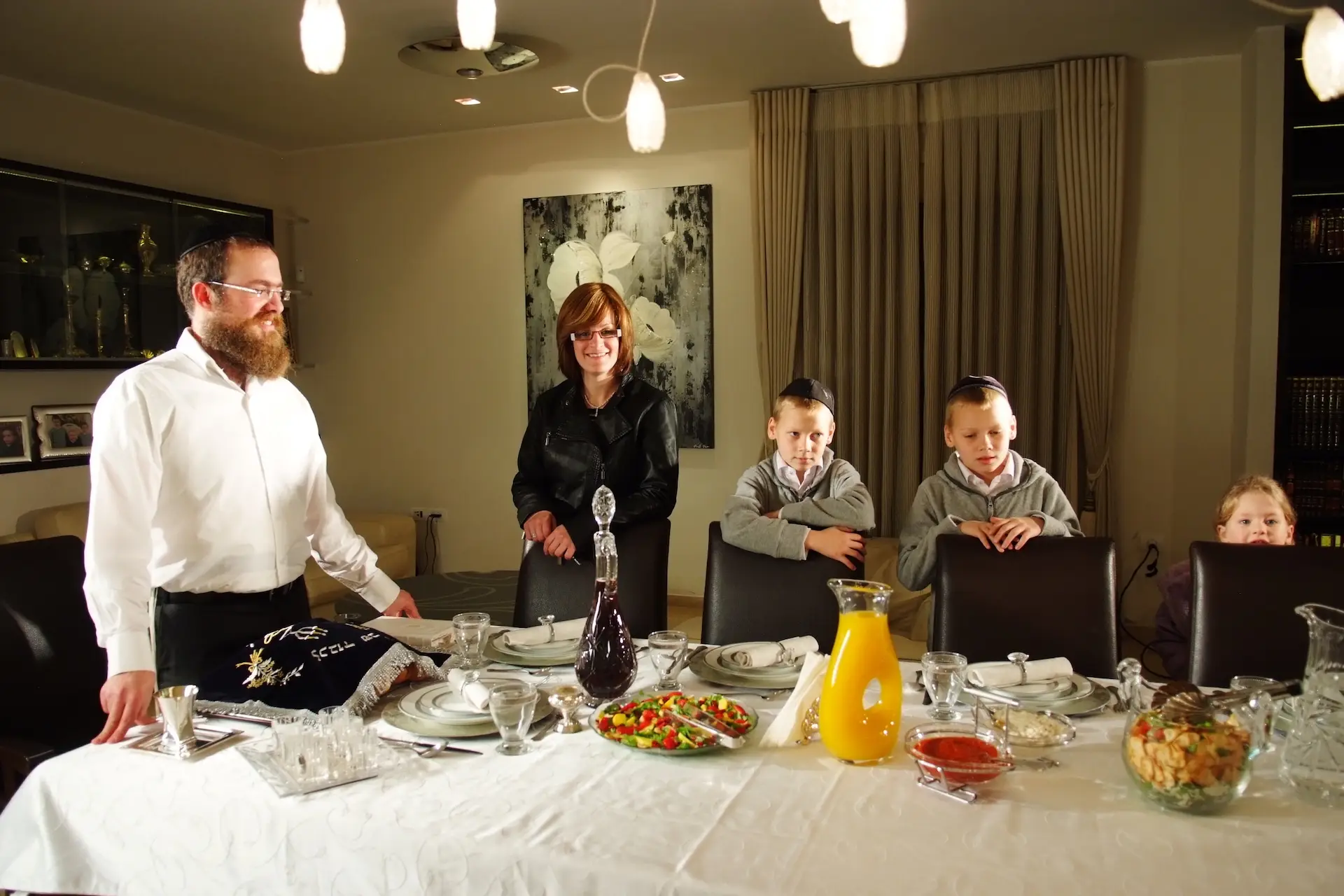
Upon returning home from synagogue on Friday night, we greet our family members with the traditional greeting of “Shabbat Shalom.”
Jewish tradition teaches us that every man is accompanied home from the synagogue on Friday night by two angels, one good and the other evil.
When they enter the home, if they find the table set in preparation for the meal, the candles lit, and an atmosphere of sanctity prevailing in the home, the good angel declares, “May it be G-d’s will that the house appear this way next week at all.” The evil angel has no choice but to respond “Amen,” even though he does not share the sentiment.
On the other hand, if the situation in the house is not as it should be, then the evil angel declares that the same should be true on the following week, and the good angel has no choice but to respond “Amen.”
Since we are escorted home by two angels, it is not considered proper to cause them to “delay.” Therefore, we greet them with the recitation of Shalom Aleichem immediately upon our arrival.
This composition consists of four stanzas. The first stanza greets the angels with the words Shalom Aleichem. In the second stanza, we invite the angels into our homes. The third stanza is a request for them to bless us, and in the fourth stanza, we bid them farewell. Each stanza is repeated three times.
Shalom Aleichem is customarily sung with a traditional melody, whose unique flavor quickly transports us into the magical realm of Shabbat.
Woman of Valor
Shalom Aleichem is followed by another song, Eishet Chayil (“Woman of Valor”), an excerpt from the Book of Proverbs, which was authored by King Solomon.
There is no time more fitting than an occasion such as this one, when the entire family is gathered around the Shabbat table, to express gratitude to the woman of the house for her dedication and hard work throughout the week.
This beautiful passage, whose lines follow the order of the Hebrew alphabet, is essentially a song of praise for the Jewish wife and mother. As we recite this passage, we enumerate the many wonderful qualities of a Jewish mother: She is a “woman of valor” who is difficult to match; she takes care of her home, her husband, and her children; she is charitable to the poor; she is wise and insightful; she is kind; and above all, her most important quality is that she is a “G-d-fearing woman.”
Blessing the Children
In many homes, it is customary for the parents (or at least the father) to bless their children on Friday night, when an atmosphere of sanctity prevails. Tradition teaches us that the angels respond “Amen” to this blessing.
The father and mother place their hands on the head of each child in order to recite the traditional blessing. For a son, the blessing begins with the words, “May G-d make you like Ephraim and Menashe.” For a daughter, the words are, “May G-d make you like Sarah, Rebecca, Rachel, and Leah.”
This line is followed by the blessing of the Kohanim: “May G-d bless you and protect you. May G-d illuminate His countenance toward you and be graceful to you. May G-d show favor to you and place peace upon you.”
- One may add additional personal blessings for each child.
We bless our sons that they should be like Ephraim and Menashe, the sons of Joseph and grandsons of Jacob, because they grew up in the alien environment of Egypt but still remained faithful to their heritage and acted in a proper Jewish way. They were wonderful children, and their father and grandfather were able to take pride in them and to be confident that they would continue to pass on their Jewish heritage to future generations.
As for our daughters, we can find no better models of proper conduct, sanctity, and purity, than the four Matriarchs of our nation: Sarah, Rebecca, Rachel, and Leah.


