











Introduction
The next step after Modeh Ani is Netilat Yadayim, the ritual handwashing procedure.
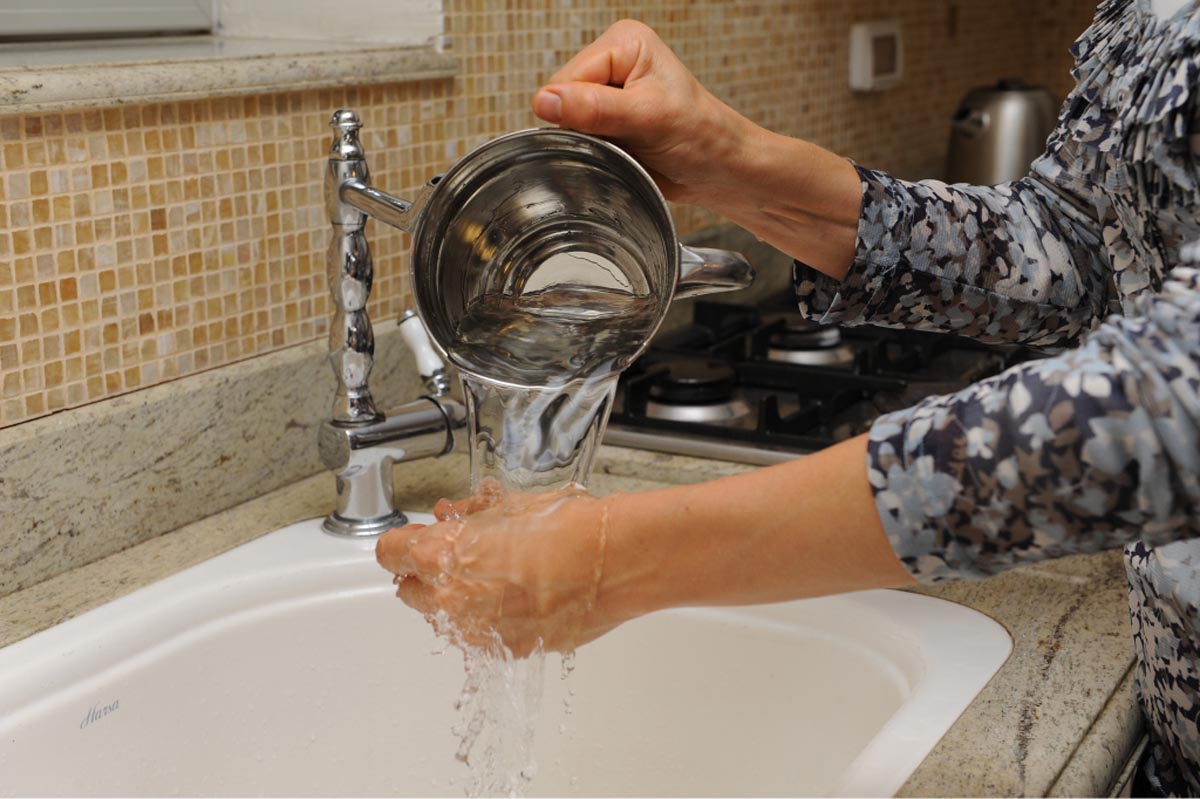
For Netilat Yadayim, we use a vessel to wash our hands.
The vessel must contain a minimum of a reviit (86 ml) of water. The general practice is to use a large cup with two handles that can easily be passed from one hand to the other.
In the past, this type of cup was known as a natla, and the washing of the hands associated with it therefore became known as Netilat Yadayim.
A Word of Caution
There are several different types of handwashing that are discussed in Jewish law. We will discuss the various types in greater detail later in this book, but in order to avoid confusion, we present here the following list of several different ways to wash one’s hands, each of which is performed at some point in a Jew’s daily life.
-
- Rinsing the hands: pouring water over each hand once or twice, without reciting a blessing afterward. This type of washing is performed before a prayer service or after using the restroom, showering, cutting one’s nails, etc.
- Washing without a blessing: pouring water three times alternately on each hand (i.e., on the right, then on the left, then on the right again, and so forth), without reciting a blessing afterward. This type of washing is practiced, for instance, when we first arise in the morning.
- Washing before the Morning Blessings: pouring water on each hand alternately, three times each, and reciting the blessing.
- Washing before eating bread: pouring water three times consecutively on one hand, then on the other, and reciting the blessing.
Why We Wash Our Hands
-
- During the era of the Holy Temple, the Kohanim (priests) used to wash their hands before beginning the daily sacrificial service. We follow their example every morning as we begin serving G-d in our own personal “Temple” (with blessings and prayers we recite, the Torah we study, and the rest of our daily lives), when we, too, are required to cleanse and purify our hands.
- When a person is asleep, a portion of his soul remains within his body; the rest of it returns to its origin in order to draw out additional reserves of positive energy for the new day. This enables negative energy (the powers of spiritual impurity) to “take hold” of the body and to rest upon it. In the morning, when we awaken and our full souls are once again within us, the impurity that occupied our bodies during the night leaves our bodies almost completely, remaining only on our hands. Netilat Yadayim cleanses our hands of this spiritual impurity.
- It is also possible that, while we were sleeping, our hands touched parts of our bodies that are usually covered (such as the armpits, the hair on the head beneath one’s head covering, the flesh of the stomach, and so forth). When a person touches any of these parts of the body, he is required to cleanse his hands. Consequently, before we begin the new day with the recitation of blessings and with our morning prayers, Jewish law requires us to perform a ritual washing of the hands in order to cleanse and purify them.
- Until Netilat Yadayim has been performed, the hands are considered to be in a state of spiritual contamination. One should therefore be aware of the following rules.
- One should not touch anything (any part of the body, any garment, any food, and so forth), with the exception of the handles of the cup that is used for Netilat Yadayim.
- One should not walk more than four cubits (about two meters). It is preferable not to get out of bed at all until Netilat Yadayim has been performed. (For this reason, many people place a cup full of water and a basin at their bedside before going to sleep for the night).
How We Wash Our Hands
The cup filled with water should be lifted with the right hand and transferred to the left hand. One should then pour water over one’s right hand one time, letting the water fall into the empty basin.
The cup should then be transferred to the right hand, and water poured over the left hand a single time. One should alternate pouring over each hand until water has been poured over each hand three times.
Each time the water is poured, it must come in contact with the entire hand.
Question: Oops! I forgot to prepare water at my bedside last night. What do I do now?
Answer: If there is no one else there who can bring you a cup of water, you can walk to the sink, pausing briefly after every meter and a half or so in order to avoid walking a full four cubits at once.
Jewish law dictates that when we perform Netilat Yadayim, as is the case with many of the other things we do over the course of the day with our hands or feet, we begin with the right. This distinctly Jewish practice shows the degree of respect that Judaism shows toward the right side. Between us, who doesn’t want to start the day on the “right foot”?
After Washing
The water that has been used for washing, which is now in the basin, is considered spiritually contaminated and should be poured down the drain.
This water should not be used for any other purpose, such as watering plants or washing dishes or the floor.
- Before walking more than two meters, make sure that you are wearing a kippa and tzitzit.


