










Introduction
The term tzitzit refers to the woolen threads that G-d commands us, in the Torah, to tie on a four-cornered garment“.
The rationale behind this commandment is explained in the Torah itself: “You shall see it [the tzitzit] and you shall remember all of G-d’s commandments, and you shall perform them, and you shall not stray after your hearts and after your eyes, after which you go astray.” When a person wears tzitzit, they remind him of all of G-d’s commandments and help him to resist the temptations placed before him by his heart and eyes.
The centrality of tzitzit in the Jewish religion is so great that we might even call them the “Jewish uniform.” This becomes clear if one simply looks at the many artistic representations that have been made of Jews throughout the century—in paintings, engravings, and the like—in which tzitzit are invariably included as one of the identifying items worn by a Jew. This shows just how much this garment essentially serves as a badge of Judaism.
The Tallit
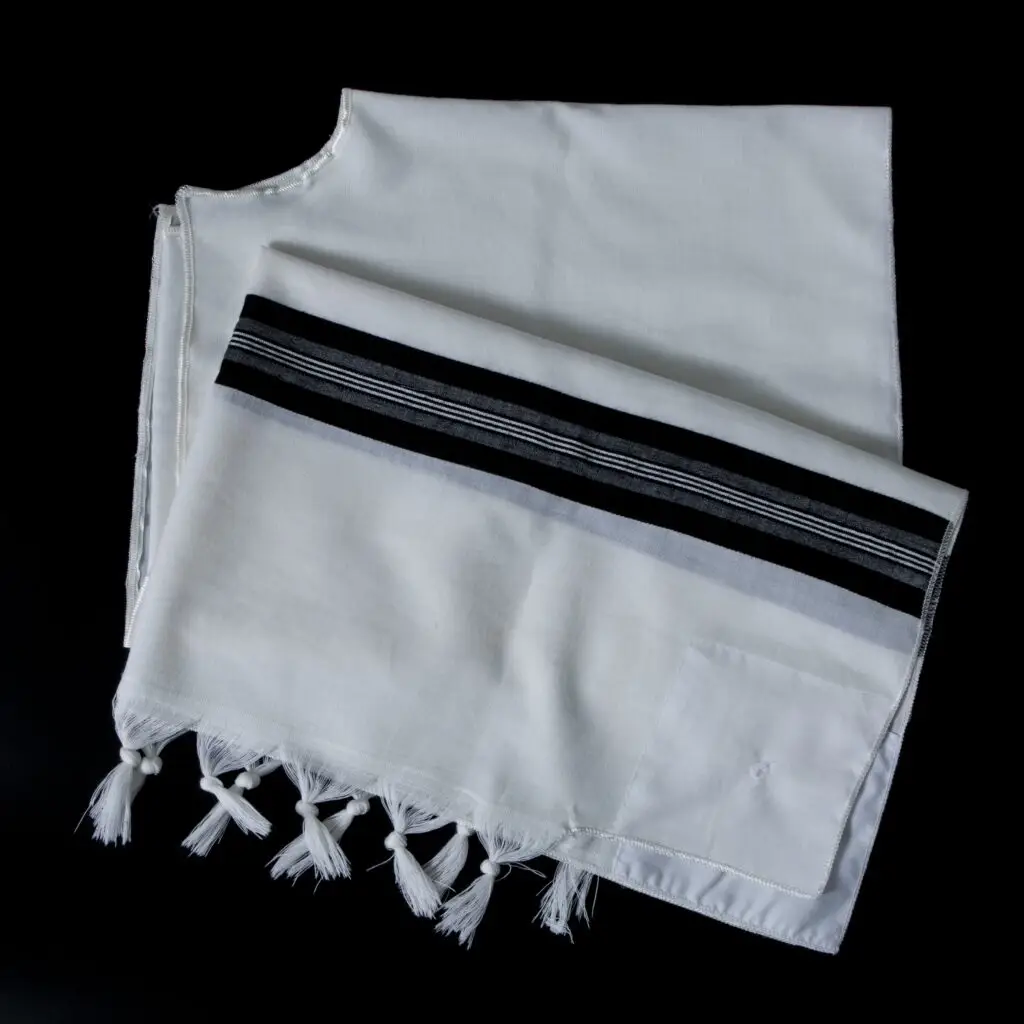
The four-cornered garment to which the tzitzit are attached is known as a tallit. “Tallit” is simply a word for “garment” in the ancient language of Aramaic. Nowadays, we use the word only in reference to a garment to which tzitzit are attached.
There are two types of “tallit”: the tallit katan, which we tend to call simply “tzitzit,” and the tallit gadol, which we generally call simply a “tallit.”
-
- Tallit katan: This term refers to a small garment with four corners, in the shape of a rectangle with a large, circular hole in the center. The tzitzit fringes are attached to each of the four corners of such a garment. This garment is generally worn beneath one’s shirt.
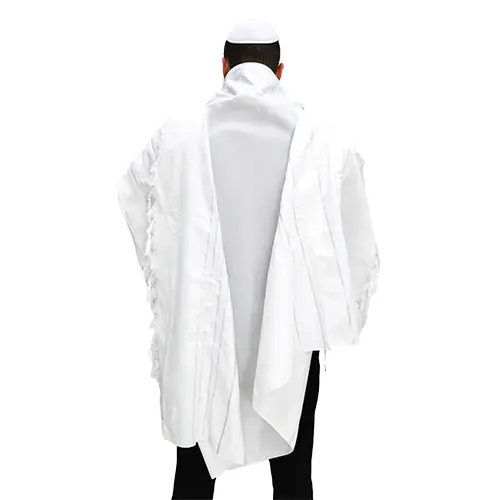
- Tallit gadol: This term refers to a large, rectangular garment without a hole in the center, which also has ritual fringes attached to its four corners. This garment is worn over one’s clothes during prayer services and at other special times.
A tallit is generally made of wool, but it also can be manufactured from other materials, such as acrylic. Of course, the material affects both the comfort of the garment and its price.
The Tzitzit Threads
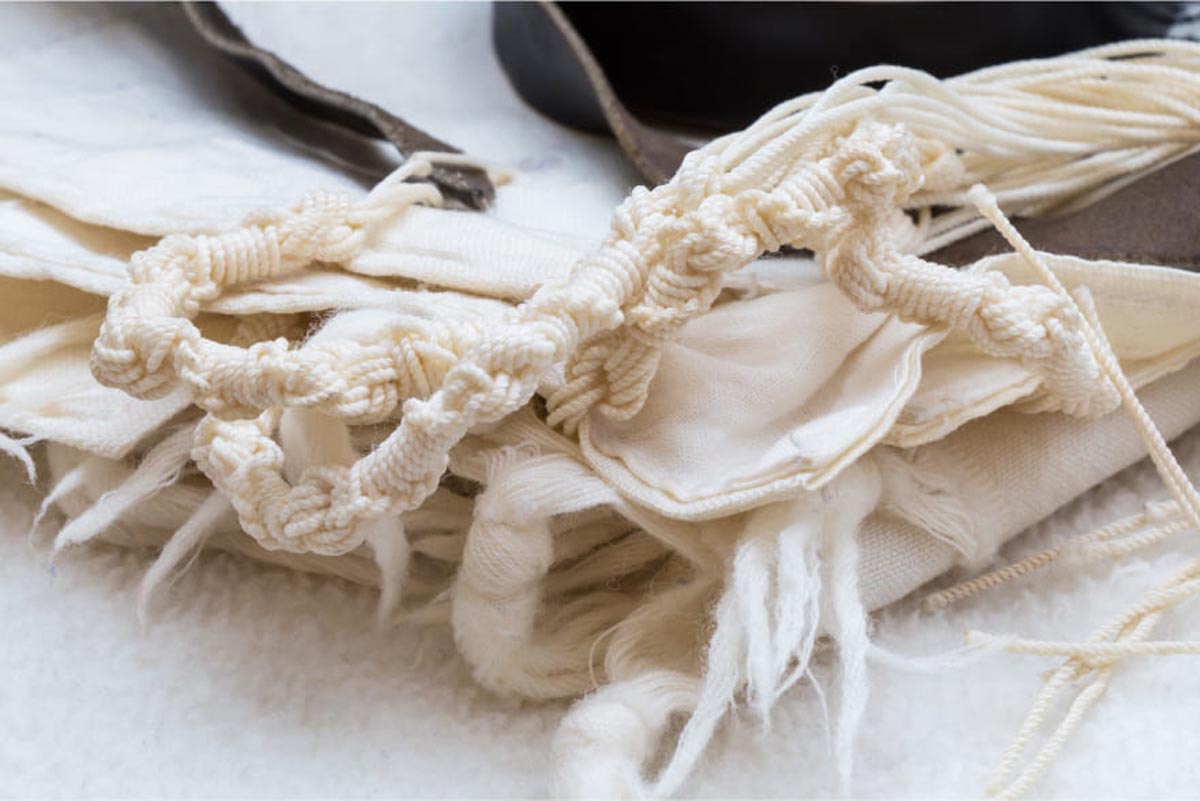
Each type of tallit has eight threads attached to each of its corners. The procedure by which these threads are fashioned is as follows: Each of the four corners of the garment contains a small hole, into which four long woolen threads are inserted. The four threads are folded over, thus producing eight threads. The threads are then wound and tied together with a series of five knots that are fashioned in a specific manner; this is what gives the garment the appearance of tzitzit.
Question: The Torah tells us that seeing the tzitzit will cause us to remember all of G-d’s commandments. How do the tzitzit remind us of all 613 commandments?
Answer: This reminder is based on the numerical value (gematria—the assignment of a specific value to each letter of the Hebrew alphabet) of the word tzitzit. The numerical value of this word is 600 (each letter tzaddik is equivalent to 90, each letter yud is equivalent to 10, and the letter tav is equivalent to 400). If we add to this number the eight threads and five knots on each corner, the sum will be 613—the number of commandments in the Torah. Thus, the tzitzit remind us of all the commandments we are obligated to observe.
This is also the reason that the Torah requires us to tie the tzitzit on all four corners of the garment, not just on one or two corners. This way, no matter where we look, we will always notice the tzitzit and be reminded immediately of the Creator of the universe and of His commandments.
The Commandment and the Time to Fulfill It
Technically, Jewish law requires us to attach tzitzit to our clothing only when we are wearing the type of garment that requires them—a garment with four square corners. A garment with fewer than four corners, or one whose corners are rounded, is exempt from the requirement of tzitzit.
Nowadays, most of our clothes are not made in this fashion, and we might never have the opportunity to observe the commandment of tzitzit if we do not go out of our way to wear a four-cornered garment. That is why it is customary today to wear a special garment with four corners in order to observe this special and very important Torah law.
Some winter coats, suit jackets, and similar garments are sold with a split in the back that makes them into four-cornered garments, to which we would be required to attach tzitzit. In order to avoid this requirement, one should make sure to round off one of the corners, thereby exempting the garment from that requirement.
In most Jewish-owned clothing store chains, the corners of the garments are rounded off before they are sold to the customers.
When Is the Commandment to Wear Tzitzit Observed?
The Torah tells us, “You shall see it [the tzitzit],” and our Sages infer from these words that the requirement to wear tzitzit applies only during the daytime, when it is possible to see them.
In today’s day and age, the invention of electric lights has made it possible to see the tzitzit at night as well. It is therefore recommended to wear one’s tzitzit during the night, as well, even while one is sleeping.
⚠️ Warning!
There are many detailed laws pertaining to the manufacture of tzitzit. These laws relate to who can prepare the fringes, how they should be prepared, who can attach them to the garment and when, what blessing should be recited when they are being made, what special order should be followed in the preparation of the threads and knots, and so forth. There are also many detailed laws regarding the actual wearing of tzitzit: What happens if one of the threads is torn? What is the minimum length that must remain? There are many more questions, as well.
As a result:
-
- One should be careful to buy tzitzit from a recognized, professional vendor, such as a reputable Judaica store, a Chabad house, and the like. Tzitzit should bear a certification of “kashrut.”
- Whenever a question arises regarding the validity of one’s tzitzit, a rabbi should be consulted.
The mitzvah of wearing tzitzit is a very great and important commandment, and it has many beneficial effects.
In addition to the fact that when we wear tzitzit all day long, we are considered to have performed another mitzvah with every passing second, the mitzvah of tzitzit is also very easy to fulfill. It requires no special exertion or effort; all that we need to do is simply wear the garment.
About the Mitzvah
-
- Only men are obligated to wear tzitzit. Women are exempt from this commandment because it is one of the “time-related commandments,” a category of precepts that women are not obligated to perform. (See Your Jewish Guide—The Life of a Jewish Woman for a detailed discussion of this idea.) The mitzvah of tzitzit is considered “time-related” because it applies only during the daytime hours.
- It is recommended to avoid walking even a distance of four cubits (two meters) without wearing tzitzit. Whenever possible, one should wear tzitzit at night, as well, and even while one is asleep.
- Tzitzit should be treated with respect. Care should be taken to ensure that the tzitzit threads do not drag on the floor.
- Every thread of the tzitzit must be at least 24 centimeters long.
- Despite the fact that the garment bearing tzitzit is considered to be invested with a degree of sanctity, one may still enter a bathroom and the like while wearing it. In this way, it differs from the tallit gadol, the “tallit” that we wear during prayer services. Since this garment is worn only for prayer, it is considered even more sacred and it is prohibited to bring it into a bathroom.
- It is preferable to wear the tzitzit on top of another garment, such as an undershirt, rather than allowing it to be in direct contact with the body.
- It is considered particularly meritorious for the garment to which tzitzit are attached to be beautiful. This applies both to the tallit katan and to the tallit gadol. It is recommended to make sure that the garment is also comfortable, so that wearing it will not be burdensome.
Question: My tzitzit threads have become torn, and my tzitzit are now invalidated. What should I do with the threats and the garment?
Answer: The threads that were torn were used in the fulfillment of the commandment to wear tzitzit, and they were thereby infused with sanctity. They should not be thrown in the garbage. The best thing to do is to place the threads, together with the garment, in a “shaimos” receptacle, which can generally be found in the synagogue. (The items placed in these receptacles are taken to be buried in a respectful manner, rather than being discarded along with simple trash.)
Techeilet
One of the details of this commandment, as it is described in the Torah, is that some of the tzitzit threads must be dyed techeilet, a color similar to sky blue. Jewish tradition teaches us that this particular dye is extracted from a sea-dwelling creature known as the chilazon.
Nowadays, we do not know exactly how to identify the chilazon, and we therefore no longer possess the techeilet color to which the Torah refers. (Some individuals claim that they have identified the chilazon, and they actually use a dye extracted from this creature to create techeilet. In practice, every individual should follow the custom of his family and his community.)


