









Introduction
Breakfast is a meal of great nutritional importance. Jewish tradition also places great emphasis on having a proper breakfast—referred to in the Talmud as “morning bread.” Breakfast should be more than just a few bites of cereal; it should be a substantive meal, one which includes the consumption of bread.
We use the term “bread” for convenience throughout this volume, but the reader should recognize that it is used in its broader sense to refer to anything in the general category of “bread,” including buns, rolls, matzah, and the like.
The Talmud teaches us that a proper breakfast of “morning bread” can protect us from many ailments and strengthen our bodies in certain ways. Even in today’s modern era, medical science recognizes the importance of having a proper breakfast every day.
Washing the Hands
Before Eating Bread
When bread is eaten at breakfast, one should perform the Netilat Yadayim ritual before sitting down to eat. The same applies to any other meal at which bread is eaten, even if only a small quantity of bread is consumed, provided that one eats more than a kezayit (an olive’s volume, approximately 27 cubic centimeters).
- Note: The Netilat Yadayim that precedes the consumption of bread differs from that which is performed every morning before the Morning Blessings.
Before the Meal
-
- One should make certain that the bread will be fit for consumption immediately after one’s hands have been washed. If the bread has just been taken out of the freezer, one should make sure that it has defrosted sufficiently to eat.
- Salt should be placed on the table so that the bread can be dipped in it, as we will explain further below.
Before Netilat Yadayim
-
- One should make sure that one’s hands are clean, since the water must come in direct contact with the hands themselves, and any foreign matter on the hands would be considered an obstruction to the ritual hand washing. The laws pertaining to this subject are somewhat complex, but the general rule is that any foreign matter that can be removed without any special effort (such as sand, mud, paint, and the like) should be removed before the hands are washed.
- For the same reason, all rings should be removed from the fingers before Netilat Yadayim.
- The amount of water used for Netilat Yadayim must be at least a reviit (86 cc), but it is preferable to use a substantial quantity of water. We are taught that a person who uses a significant quantity of water for Netilat Yadayim may be blessed with an overflowing bank account, as well.
The Netilat Yadayim Procedure
The following is the procedure for the ritual washing of the hands:
-
- Lift the full cup of water in the right hand, transfer it to the left hand, and then use that hand to pour the water three times in succession on the right hand.
- Transfer the cup to the right hand and pour from it three times in succession on the left hand. Leave a little bit of water on the left hand and rub the hands together while they are wet.
- Raise the hands slightly and recite the blessing: “Blessed are You, G-d, our L-rd, King of the universe, Who has sanctified us with His commandments and has commanded us about the washing of the hands.”
- Dry the hands with a towel (not on your clothes!) and proceed immediately to the table.
- One should not speak after reciting the blessing on Netilat Yadyaim, until after one has recited the blessing of Hamotzi and eaten some bread.
Reciting a Blessing and Breaking Bread
The bread should be held in both hands, using all ten fingers, and one should recite the blessing of hamotzi: “Blessed are You, G-d, our L-rd, King of the universe, Who produces bread from the earth.”
The bread should then be dipped in salt three times.
When reciting a blessing, one should pay close attention to every word of the blessing. A blessing is the means by which we express gratitude to G-d, and it should therefore be recited in a respectful, dignified fashion.
From the time the blessing is recited until after the first bite of bread, one should neither speak nor engage in any other activity not related to eating.
-
- If one has a whole roll or loaf of bread, it is preferable to recite the blessing while it is still whole, and to cut it only after the blessing has been recited.
- There is a custom to refrain from eating the two ends of a loaf of bread. It is not necessary, however, to be overly “scrupulous” regarding this custom; one may simply cut off a small piece of bread at each end and then consume the rest of the loaf.
What is the reason for dipping the bread in salt?
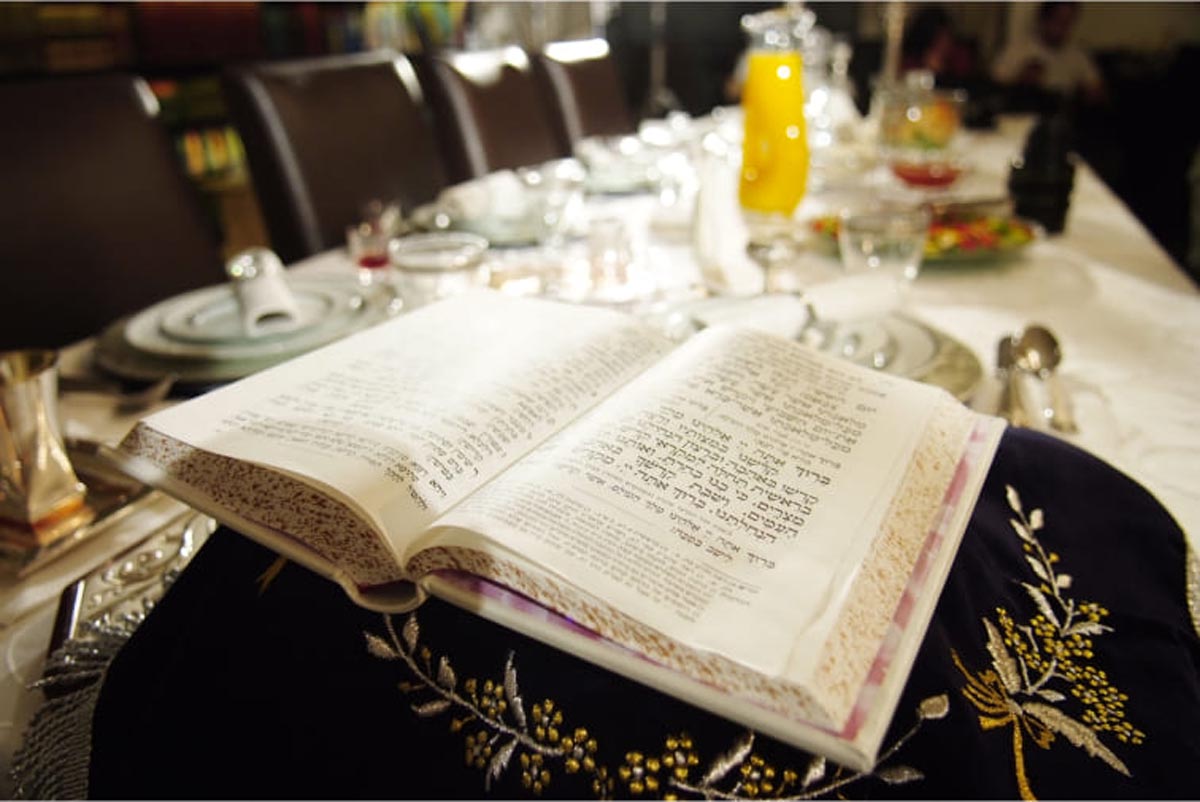
The table at which we eat is viewed as corresponding to the altar in the Holy Temple, on which the sacrificial offerings were brought. In the Temple, an animal—a physical entity—would be offered as a sacrifice to G-d, an act that consecrated it and transformed it into a sacred item. When we eat, we do the same thing; whatever food we consume is consecrated by the blessings recited before and after we eat it, and by the fact that we consume it in order to have strength to serve G-d.
The Torah instructs us to place salt on every sacrificial offering brought on the altar. It is therefore customary to dip our bread in salt at our own personal “altars”—our tables—as well.
Why ten fingers?
We hold the bread with all ten fingers because there are ten Biblical commandments that are observed in the process of making bread, from the time the field is plowed in order to plant wheat, through the course of the grain’s growth, and until the final production of the finished product.
It is also interesting to note that the blessing of hamotzi consists of exactly ten words.
During the Meal
-
- One should remain seated while eating, rather than moving about or standing.
- One should eat in a refined, dignified manner, slowly and deliberately.
- One should not eat from a loaf of bread while it is still whole. Rather, a slice should be removed from the loaf and then consumed.
- Jewish law requires us to treat bread with respect. For instance, when we wish to pass some bread to someone sitting at the other end of the table, we are taught that the bread should not be thrown; instead, it should be passed from one person to the next, in a manner that is more respectful to the bread.
- For the same reason, one should make every effort to prevent crumbs of bread from falling on the floor.
- One should refrain from talking while eating. Speaking and eating at the same time may be dangerous, since the food may “go down the wrong pipe” (i.e., enter the trachea rather than the esophagus), causing one to choke.
- During every meal—although not during the actual eating—one should endeavor to say some “words of Torah”—a Jewish law, some verses from the week’s Torah portion, a passage from the Mishnah, or any other passage or idea from the Torah.
- One should not leave the place where he is eating until the Grace After Meals has been recited to conclude the meal.
- All knives should be removed from the table, or at least covered, before the Grace After Meals.
- The tablecloth and all remaining bread should be kept on the table until after the Grace After Meals.
Nowadays, the Holy Temple does not exist and we do not have the ability to bring sacrificial offerings on the altar. We are taught that the tables on which we eat serve instead as our “personal altars,” and we atone for our sins by extending hospitality to guests and sharing our food with those less fortunate. These acts of charity and kindness are viewed as being tantamount to the bringing of a sacrifice.
Various Foods During the Meal
In our chapter on blessings, we explained that whenever a food is eaten on its own, its consumption must be preceded and followed by specific blessings, and that there are a number of different blessings, each of which applies to a different category of food items. We also noted that, in general, when a food is eaten in the context of a meal at which bread is consumed, there is no need to recite the blessings over that particular food. Rather, the blessing of hamotzi that begins the meal is considered to have “covered” anything eaten during the course of that meal, as is the Grace After Meals with which it concludes.
The rationale behind this rule is that all other foods eaten in the course of a bread meal are considered to be subservient to the primary element of the meal—the bread itself. The other food items consumed in the course of such a meal are viewed as items that help achieve the purpose of the meal: to eat and be satiated. Some of these foods, such as spreads, are actually eaten together with bread, while others are eaten in the course of the meal with the goal of creating a feeling of satiety.
Based on this rationale, it can be easily understood that there are some foods that are exceptions to this rule and require a separate blessing even when they are consumed during a bread meal.
-
- Wine: In Jewish tradition, wine is viewed as a beverage of unique importance and significance, to the point that it has a blessing entirely of its own—the blessing of hagefen, “Who creates the fruit of the vine.” On all other beverages, in contrast, the proper blessing is shehakol. The special significance of wine applies even when it is drunk in the course of a bread meal, and its blessing is recited even when it is consumed during such a meal.
- Desserts: This course, served at the conclusion of a meal, is not considered “covered“ by the blessing recited on bread. The appropriate blessing should be recited on any such food (ha’etz for fruit, ha’adamah for watermelon or other types of melon, shehakol for ice cream, and so forth). Since the purpose of the dessert course is not to satiate, but rather to provide a treat with which to conclude the meal, foods that are served as dessert are not considered to be part of the “package” that includes the bread.


