















Introduction
As we have already seen, we recite blessings on things from which our bodies benefit. Out of all the types of physical benefit and enjoyment that exist in the world, Jewish law accords a special status to the blessings recited over food and drink.
As a whole, the blessings on physical enjoyment are associated with the types of enjoyment we experience with our physical senses—our sense of taste, our sense of smell, our hearing and our sight. We will first focus on the blessings recited on food and drink, and we will then turn our attention to other blessings.
In fact, it is only natural that the greatest quantity of blessings should pertain to the pleasure we derive from the world through our taste buds. G-d created us in such a way that we need to add “fuel” to our bodies every few hours in the form of food and drink, and we all prefer to do that in a way that is pleasing to the palate.
Perhaps we can say that G-d created us with a need to eat regularly in order to provide us with a sort of consistent reminder of another, no less important need: the need to provide “nourishment” for our souls. Just as we ingest physical food, we must also “feed” our souls in a spiritual sense by observing G-d’s commandments and studying the Torah. This, too, is something that must be done at least every few hours, in order for us to have a “healthy soul” in a healthy body.
All of the food and drink in our world actually belongs to G-d. (As the verse in Psalms states, “The land and its fullness are G-d’s.”) He channels to every item of food a constant flow of life and vitality that gives it taste, fragrance, and physical form. It is only fitting, then, for us at least to thank G-d for our food by reciting blessings before we eat. If we fail to do so, it would be considered tantamount to “theft,” for we will have eaten G-d’s food without His permission.
Because of this idea, our Sages instituted the requirement for us to recite a blessing before eating any food. The blessing acts as a request for Divine permission for us to consume the food or drink that is before us. The Sages also required us to recite another blessing after we eat or drink, in order to give thanks to G-d for the nourishing food that we have received from Him.
Blessing Before Eating
Before you place any food into your mouth, you must make sure to recite the correct blessing on the food.
There are six blessings that may be recited before eating a food item:
-
- The blessing of hamotzi: “Blessed are You, G-d, our L-rd, King of the world, Who produces bread from the earth.” This is a blessing that is designated specifically for bread. It encompasses all kinds of bread: sliced bread, a roll, a bun, a pita, and so on.
-
- There are various criteria that an item must meet in order to be considered “bread” from the vantage point of Jewish law. The following are a few of the conditions:
- It must be made from one of the “five species of grain” recognized by Jewish law: wheat, barley, spelt, rye, and oats.
- It must be baked, not fried or produced through any other cooking process.
- The flour must have been mixed with water, not with fruit juices or other liquids.
- It must be made from dough only and not contain any filling.
- The blessing of mezonot: “Blessed are You … Who creates types of sustenance.” This blessing is recited on foods that are made of any of the five species of grain but fail to qualify as “bread.” In general, this blessing applies to most of the baked goods that are available on the market today.
- The blessing of hagefen: “Blessed are You … Who creates the fruit of the vine.” This is a special blessing recited before drinking wine.
- The blessing of ha’etz: “Blessed are You … Who creates the fruit of the tree.” This blessing is recited on fruits that grow on a tree (such as apples, oranges, guavas, and the like).
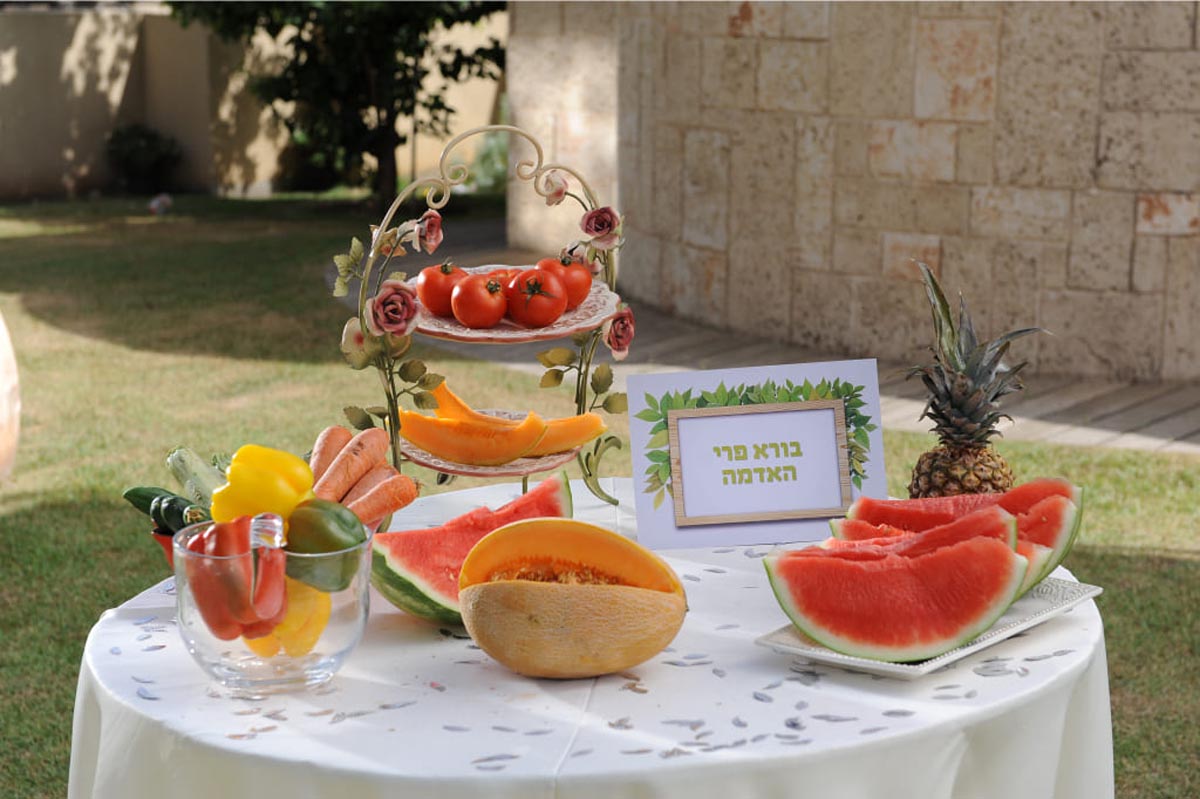
- The blessing of ha’adamah: “Blessed are You … Who creates the fruit of the ground.” This blessing is recited on vegetables that grow from the ground (such as carrots, onions, potatoes, and so forth).
- The blessing of shehakol: “Blessed are You … that everything was created by His word.” This blessing is recited on meat, fish, beverages, eggs, and so forth—any foods that do not meet the criteria for any of the other five blessings.
- A word of caution: When the form of a food is changed significantly, it sometimes “loses” its regular blessing, and a different blessing is applied instead. This is particularly relevant to certain commercially produced foods made of ordinary foods that have undergone significant processing. For example, while the proper blessing for corn is ha’adamah, if it is turned into corn flour and then made into corn flakes, the blessing would be shehakol. (See next page for a detailed chart of the appropriate blessings for many food items.)
Using the Right Hand
-
- When reciting a blessing on any item of food, one should hold the food item in one’s right hand.
- When eating a cooked food such as soup or rice, which is not ordinarily held directly in the hand, one should still use the right hand to hold the food with a fork or spoon while reciting the blessing.
Rules of Blessings
When a person wishes to eat more than one food that is subject to the same blessing (for instance: an apple and an orange, both fruits of a tree and require the blessing of ha’etz, or a bowl of soup and a piece of chicken, both shehakol foods shehakol is recited), it is sufficient to say the blessing once, before the first food. There is no need to recite the same blessing more than once, even when different foods are being consumed. The first blessing is considered to have “exempted” the person from reciting a blessing on the subsequent foods.
-
- This rule applies only when one has planned to eat both foods during the same meal. Thus, if a person recites the blessing of ha’etz when there are only oranges on the table, and then a bowl of apples is suddenly brought out from the kitchen, he should recite the blessing of ha’etz again before partaking of the apples.
- Similarly, a person is exempt from reciting a blessing again only as long as his meal is still in progress and he plans to continue eating foods of that type. If a person has already concluded his meal, recited the blessing after his food, and gotten up from the table, he must say the blessing again if he decides to continue eating. Furthermore, even if a person simply decides that he will not eat any more, and then he changes his mind and desires to continue, the blessing must be repeated even if he never left the table.
- When bread is eaten at a meal, many of the usual rules regarding the blessings over food do not apply. The blessing on the bread itself “covers” all of the other foods that are served during the course of a meal, with the exception of desserts and wine; all other foods do not require their individual blessings to be recited. The blessing on bread remains in effect, with regard to all other foods, until the Grace After Meals is recited. We will discuss this topic at greater length below, in our article on Breakfast.
Order of Blessings
What is the procedure when we wish to partake of a variety of foods, all of them subject to different blessings? In such a situation, Jewish law dictates the order in which the blessings should be recited. (Of course, one should take a taste of each food after reciting the appropriate blessing.) The following is a list of the blessings in the order in which they should be said (not including the blessing over bread):
-
- Mezonot
- Hagefen
- Ha’etz
- Ha’adamah
- Shehakol
Let us illustrate this with an example. Imagine that you are at a get-together with some of your friends, and a number of different foods are placed on the table: soft drinks, watermelon, assorted fruit, some baked goods, and a bottle of wine. In our scenario, you plan on partaking of all of the foods before you. What should you do?
Based on the list above, the first food that you should sample is a baked item, on which the blessing of mezonot is recited. Next, you should have some wine, on which you must recite the next most “important” blessing, that of hagefen. The wine should be followed by fruit, on which the blessing of ha’etz is said. Only then should you take your first taste of watermelon — a fruit grown in the ground — after reciting the blessing of ha’adamah, and then you may finally permit yourself to recite the blessing of shehakol on another beverage.
- Of course, if you are not interested in partaking of all the foods before you, there is no need to do so. In such a case, the blessing is recited only on the foods that you do wish to eat. We are not required to eat foods that we do not desire simply in order to recite the blessing on them.
The Seven Species
The “seven species” are seven types of produce that grow in Israel and that are mentioned in a Biblical verse describing the abundant crops of the Land of Israel. The Torah calls the Land of Israel “a land of wheat and barley, grapevines, figs, and pomegranates, a land of oil-producing olives and honey.” These “seven species” are considered to have a special significance by virtue of the fact that the Torah uses them to illustrate the fertility of the Land of Israel.
The honey mentioned in this verse is not bee honey, but date honey. Therefore, it refers to the date fruit from which date honey is produced.
Our Sages have determined that this verse teaches us the order of importance of these species. The word “land” appears twice in the verse, and the importance of a particular species is determined by its proximity to that word in the verse. Thus, the species that are mentioned first after each word “land” have the greatest importance, followed by those mentioned second. The remaining three species—which appear third, fourth, and fifth after the first word “land,” respectively—are also listed in descending order of importance.
Of the seven species listed in the verse, five of them are subject to the blessing of ha’etz. Based on the rules we have seen, if a person plans to eat more than one of these items, he should recite the blessing of ha’etz on the first fruit in the following list that is available to him: olives, dates, grapes or raisins, figs, and pomegranates.
-
- The first two species enumerated in the verse are wheat and barley. These species are generally made into baked goods, on which we recite the blessing of mezonot. That blessing, of course, takes precedence over all others, as we noted above. Our discussion here pertains only to the order in which we give priority to fruits whose blessing is ha’etz.
- If a person plans to eat both “regular” fruits and fruits of the seven species (for instance, apples and grapes), the Your Jewish Guide 69 blessing should be recited on the fruit of the seven species (in this case, the grapes).
- spite of the above, if a person has a preference for a particular fruit, even if it is not one of the seven species, he may partake of that fruit first and recite the blessing on it. The Torah also attributes significance to a food based on an individual’s personal preferences. As we noted above, the blessing of ha’etz need not be repeated when one goes on to partake of another fruit, since the initial blessing covers all the fruits that one will eat.
Blessing after Eating
After we have eaten, we are required to recite another blessing praising and thanking G-d for the food that He has given us. There are three types of “after-blessings”: the Grace After Meals, the Blessing After Certain Foods, and the blessing of borei nefashot.
The Grace After Meals
This series of blessings is recited after the consumption of any type of bread. We will discuss this prayer in greater detail below, in our chapter on breakfast.
Blessing After Certain Foods
This is a blessing recited after the consumption of grain foods, wine, or fruits of the seven species.
This blessing is called the Blessing After Certain Foods because it functions as a sort of abridged version of the first three blessings of the Grace After Meals. The subjects of these three blessings are: gratitude to G-d for the sustenance He has given us, the Land of Israel, and a prayer for the rebuilding of Jerusalem and the Holy Temple. The Blessing After Certain Foods incorporates all three of these subjects.
The beginning and end of this blessing vary based on the type of food on which it is recited.
When grain foods have been eaten, the blessing begins and ends by thanking G-d for “the nourishment and the sustenance” (al hamichya). When it is recited on wine, this phrase is replaced with the words, “the vine and the fruit of the vine” (al hagefen). And when it is recited after the consumption of fruits of the seven species, we use the phrase, “the tree and the fruit of the tree” (al ha’etz).
-
- If the blessing is being recited after the consumption of two of these categories of food, or of all three, then all the appropriate phrases should be included. The proper formulation for the blessing in these cases appears in standard prayer books.
- On Shabbat, Rosh Chodesh, and Festivals, specific phrases are inserted into the blessing to allude to the day. These phrases are also printed with the text of this blessing in standard prayer books.
Borei Nefashot—“Who Creates Many Souls”
After the consumption of any food or beverage for which the Grace After Meals and the Blessing After Certain Foods are not recited, we recite the following brief blessing: “Blessed are You, G-d, our L-rd, King of the universe, Who creates many living things and what they lack, for all that You have created to sustain the life of every living thing; blessed is He, the life of the worlds.”
With these words, we thank G-d for creating us (referring to ourselves as “many living things”) and providing us with all of our needs (“what they lack”), as well as those foods that we enjoy but that are not essential for our continued existence (“for all that you have created”).


