








Introduction
Apart from the fact that we are forbidden to eat chametz (leavened grain products), there is an additional prohibition from the Torah: no chametz should remain in our possession during the Passover holiday, as it is written: “No leaven shall be found in your houses for seven days… and no leaven shall be seen by you in all your territories for seven days”.
This prohibition begins about an hour before noon on the 14th day of Nisan, and chametz is forbidden during Passover in any form: raw, cooked, solid, or liquid. Unlike other non-kosher foods that are only prohibited to eat, chametz is also prohibited for benefit: we may not use it during the holiday for other purposes in any way, such as: feeding it to a dog, selling it, and so on.
The prohibition applies only to chametz that belongs to us or to another Jew, but it is permissible to have chametz in our possession that belongs to a non-Jew. Therefore, we sell the chametz products that we do not burn, as well as all chametz utensils, to a non-Jew before Passover, place them in a closed and guarded place, and write on it ‘sold to a non-Jew’ or ‘chametz’.
- Be careful – Chametz!
- Approaching the holiday, we should stock up on a sufficient quantity of matzot, wine and other holiday needs. We should be careful to purchase food that is produced under the supervision of a reliable authority for Passover. Many products, even those that are not completely chametz – have chametz mixed in, and this should be considered even when it is not explicitly stated on the food packaging that it contains grains, extracts, or various substances made from grain.
- There are many products that at a superficial glance do not seem to have kashrut issues but in fact contain chametz ingredients, or were produced in vessels, machines, or ovens where chametz products are also produced, and therefore, it is necessary to thoroughly investigate each product to see if there are labels or stamps stating ‘Kosher for Passover’.
Chametz: Examination, Nullification, and Removal
As we mentioned before, we are obliged to remove the chametz from the house before Passover. To ensure that the task is indeed completed, there are three steps required to ensure that the effort succeeded: 1) Checking for chametz. 2) Nullification of chametz. 3) Removal of chametz.
Here’s a detailed explanation of each step:
Checking for Chametz
Although the prohibition of chametz from the Torah only starts from noon on the 14th of Nisan (which is the eve of Passover), we perform the “Checking for Chametz” on the preceding night – after the 13th of Nisan, for two reasons:
- In the evening, people are at home and will not forget to perform the chametz check.
- The chametz check is performed by the light of a candle, and therefore we do the check in the evening, when the candlelight is more useful and effective.
When the 14th of Nisan – the eve of Passover – falls on Shabbat, the chametz check is performed on Thursday night, after the 12th of Nisan.
Before checking for chametz, you should sweep and wash the house thoroughly again. Also, you should scrub and clean the chairs, tables, and walls that came into contact with chametz during the year.
Order of the Check:
- The chametz check should be conducted immediately after the evening prayer, at nightfall.
- A person who is accustomed to praying the evening prayer at home should first perform the check and only then pray.
- No work should be performed during the half hour before “tzeit hakochavim“ (the appearance of the stars), and one should also avoid studying or engaging in other activities that might make us forget the check. The exact time of “tzeit hakochavim“ can be found on timetables and on the internet.
- Since the house is typically already kosher for Passover, and there may be a situation where there is no chametz (leavened bread) in the house at all – we should therefore place 10 hard pieces of chametz (e.g., pita pieces) wrapped in paper in different places in the house. During the check, we will find and collect them. It is better to note down the places where we have placed these pieces, in case one of them is not found.
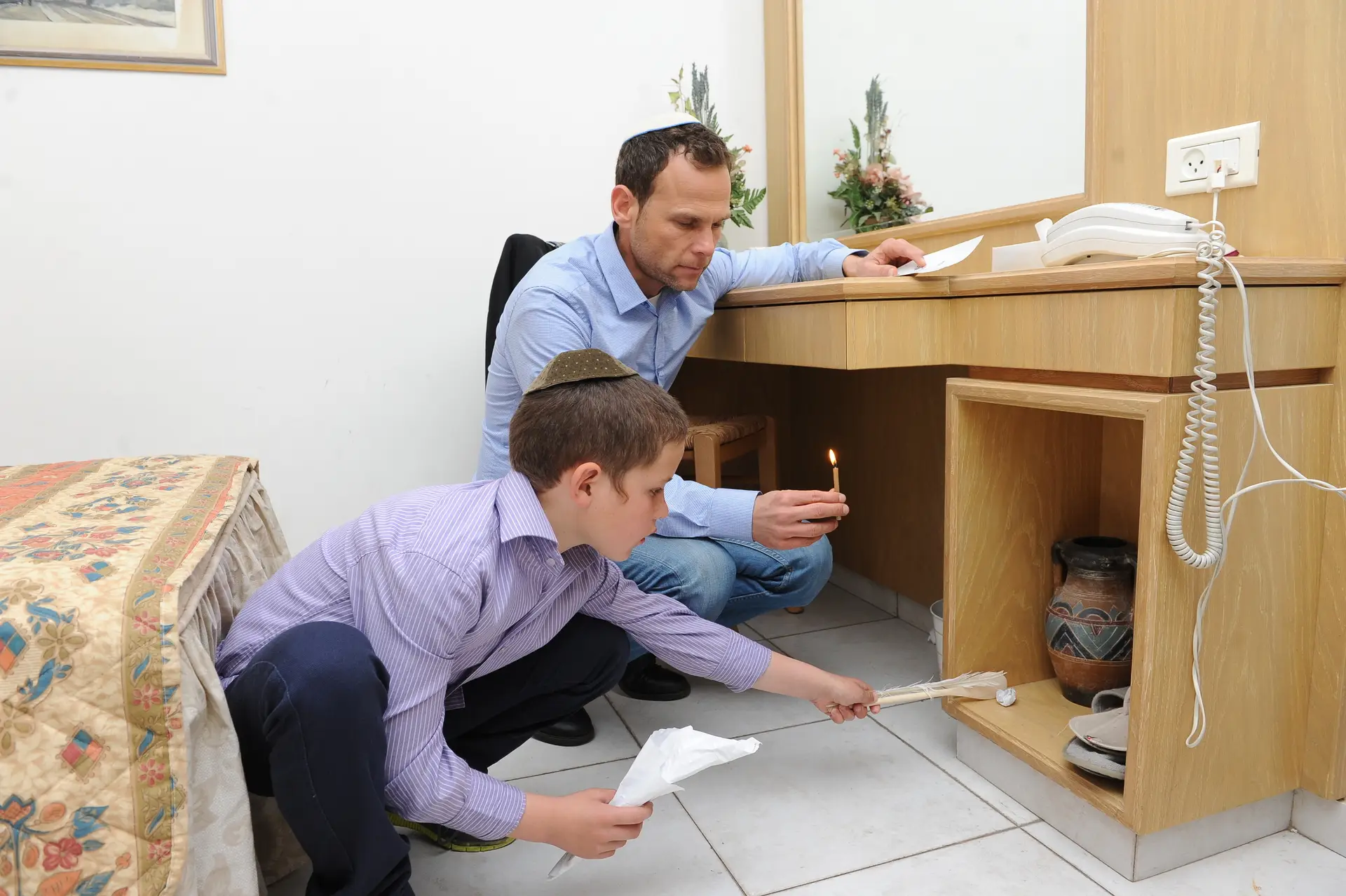
- You should equip yourself in advance with ‘checking tools’: a beeswax candle, a chicken feather, a paper bag, and a wooden spoon. Today, such a kit can be purchased at any Judaica store.
- Before the check, it is good to wash your hands, so we fulfill the commandment with cleanliness and purity.
- The head of the household holds the lit candle and blesses: “Blessed are You, LORD our God, King of the universe, who has sanctified us with His commandments and commanded us concerning the removal of chametz”, and the listeners respond with ‘Amen’.
- Immediately after the blessing, the check should begin. During the time in which we are checking the house for chametz, one should not engage in unrelated conversations.
- The candle’s light should be moved around the entire house, including those places we have cleaned well and are ‘sure’ there is no chametz left. Especially check those places that require special attention: holes and cracks in the walls and floors, hidden corners, small parts of children’s toys, closets, bags, children’s collections, baby strollers, and similar.
- In the yard or in the stairwell, just like in the house – you should look for holes and cracks to ensure that even a crumb of chametz did not remain. If there is concern that chametz may have entered ‘sterile’ areas, such as an office, store, basement, or warehouse – they should also be checked and searched.
- The pieces of chametz that were dispersed in advance, as well as chametz discovered during the check, should be put into the bag using the spoon and the feather.
- Immediately after the check, we move to the “nullification of chametz” phase.
Sure, I’ll translate each of the given paragraphs:
Nullification of Chametz
After the “checking for chametz,” we ‘nullify’ and render ownerless any chametz that we might not have found, by saying the phrase printed in the prayer book: “All leaven or anything leavened which is in my possession, which I have not seen or removed and about which I am unaware, shall be nullified and become ownerless like the dust of the earth.” The phrase for the nullification of chametz must be understood, and therefore, someone who does not understand Aramaic should say it in Hebrew: “Any chametz or leaven that is in my possession, which I have not seen, which I have not removed and of which I am not aware – shall be nullified and become ownerless like the dust of the earth.”
At the end of the check and nullification, any remaining chametz in the house should be stored in a special place, marked with a sign: “Chametz”, or “Sold to a non-Jew”.
The chametz that we wish to continue to eat that night and the next morning until the end of the time for eating chametz, should be kept in a securely closed and well-guarded place (from children and pets) so that it does not spread in the rooms of the house. The chametz should be eaten in a separate place from the rest of the rooms and the kitchen that are kosher for Passover.
Burning (Biur) of Chametz: We burn the chametz on the 14th of Nisan – the eve of Passover. See later in Passover Eve.
Sale of Chametz
The “sale of chametz” is a process in Jewish law, initiated to deal with the absolute prohibition on chametz (leavened bread products) on Passover. As we mentioned before, it is forbidden for even a crumb of chametz to remain in our possession during the holiday. However, when we sell the chametz to a non-Jew, the problem is effectively resolved, as this prohibition does not apply to him.
Since the sale must be carried out according to Halacha (Jewish law), it must be done through a rabbi. We should go to him during the days before Passover and instruct him to sell our chametz to a non-Jew. So that he can indeed sell on our behalf, we appoint him formally and practically as our ‘agent’ by lifting an object belonging to the rabbi.
The sale can be made until the morning of the 14th of Nissan (the day before Passover), but it is better not to wait until the last minute, and to approach the rabbi a few days beforehand.
In the sale document, you should detail the locations where the chametz is placed in the house.
Even those who are far from the rabbi can sign the appropriate form and send it to the rabbi by mail, fax, or email.
Here is an example of a Chametz sale form:
I, the undersigned, appoint Rabbi ____ to sell all the chametz I possess.
The chametz is in my home, street ____ house number ____ city _____ place _____ (specify the location of the chametz in the house). I grant power and permission to the Rabbi to sell the chametz and treat it as his own, as detailed in the Chametz sale document.
Signed by ___________________.
- After dealing with the removal, nullification, and sale of chametz, we move on to the food that symbolizes Passover more than any other: Matzah.


