













Introduction
The wedding day is undoubtedly a busy, exciting (and stressful…) day. Despite this, one must remember that it is an incredibly important day from a spiritual perspective and should be utilized appropriately. This day even has spiritual influence on the future married life.
This is why on this day, one should increase their good deeds and mitzvot (commandments). One should give charity, pray to God, read chapters from the Book of Psalms as much as possible, and the groom should put on tefillin (phylacteries). Even the close family members should join this spiritual ‘celebration’ – their actions too have the power to bring good influence to the young couple.
In Judaism, this day is considered the ‘Yom Kippur’ (Day of Atonement) for the young couple due to its uniqueness and sanctity. This is also why on this day it is recommended for the bride and groom to fast until after the chuppah (wedding canopy) – just like on the actual ‘Yom Kippur’.
- However, if the wedding day falls on Rosh Chodesh (the first day of the Jewish month), Hanukkah, Isru Chag (the day after a Jewish festival), Tu B’Av (the 15th of the Hebrew month Av), or Tu B’Shevat (the 15th of the Hebrew month Shevat) – they do not fast. The fast ends after the chuppah, even when it takes place during the day.
Before the Chuppah
Before going to the chuppah, you will meet with the rabbi who will organize a few things for you:
- Fill out the ketubah (marriage contract).
- Have the witnesses and the groom sign, and make a ‘kinyan’ (an act of acquisition; see further below).
- See the ring – with which the kiddushin (betrothal) will be performed and check that it was acquired by and with the money of the groom.
The Ketubah
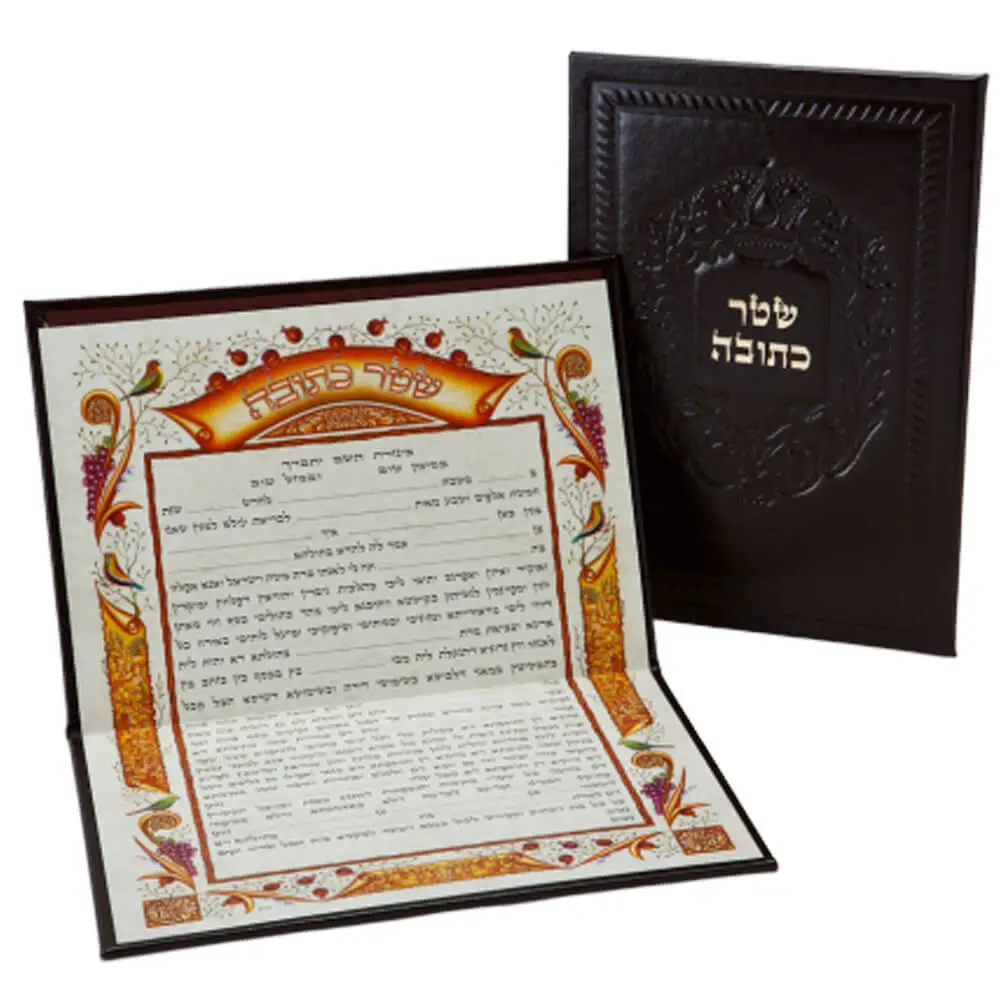
The ketubah is a legal document instituted by our sages in order to anchor the rights of the woman and to prevent the husband from easily divorcing her. Among other things, he signs on a significant sum of money which he must give in case of divorce – to deter him from doing so.
In the past, before the era of printing, the scribe would write the ketubah (marriage contract) in full for the marrying couple. Nowadays, when everything is printed, spaces of a few empty words are left in certain areas in the ketubah. These must be filled in according to the personal details of the groom and the bride, such as names, the amount of money, and more.
During your meeting with the rabbi before the wedding, he will fill out this document and explain what is written in it to the groom so that he knows what he is committing to. At this point, the rabbi will also fill out the ‘copy of the ketubah’, which he will pass on to the rabbinate where you have registered for marriage, in order to document your wedding for future generations.
Under the chuppah (wedding canopy), the ketubah will be read and handed over by the groom to the bride.
- The ketubah should be kept in the couple’s home throughout all the years of marriage.
- In the event that it is known that the ketubah has been lost or erased, you should arrange as soon as possible for a new ketubah. This can be done at the local rabbinate, which has a copy of all the ketubahs made in its areAnswer
The ketubah is written in ancient Aramaic – the language spoken by the Jewish people at the time when our sages, of blessed memory, composed this document.
Here is the main part, translated into Hebrew:
On the day __ of the week, on __ of the month __ of the year __, here in __ let it be built and established, we are witnesses of how the groom __ son of __ from the family of __ said to the bride __ daughter of __ from the house of __ ‘Be my wife according to the law of Moses and Israel, and I will serve, honor, provide, and sustain you according to the law of Moses and Israel, and I will give you the fixed amount specified in the ketubah’ and the bride agreed, and we acquired from the hand of the groom. Declaration: _____ witness and declaration: _____ witness, the groom___________
The witnesses
To give validity to the ketubah and the obligations therein, it must be signed by two witnesses who are not relatives of the couple.
- At the chuppah ceremony, there are many rules about who is suitable to be a witness. An improper witness’s signature can invalidate the document and nullify the kiddushin (betrothal), so the choice of witnesses should be coordinated with the rabbi.
Upon completion of writing the ketubah, acquisition will be made and thereafter the witnesses and the groom will sign.
The acquisition is a process by which the groom’s obligation in the ketubah is intensified.
These witnesses will usually also be the witnesses of the marriage (covering the bride’s face, the chuppah). Without them, you will not be a couple even though the entire process was done correctly. They need to see the act of kiddushin (such as giving the ring), and only in this way do the nuptials take effect.
The ring
From a Torah perspective, the kiddushin is performed by placing a ring belonging to the husband (a ring without a precious stone), on the woman’s finger by the husband. For this, two things are required:
- The ring should have a minimal value – something that certainly exists today in wedding rings. Under the chuppah, the rabbi will show the ring to the witnesses and verify with them that it indeed has a minimal value.
- The ring should be in the exclusive possession of the husband. For this purpose, the rabbi will ensure that it was purchased with his money, and will even demand from him to raise it – through this act of raising it, he ‘acquires’ it and it becomes his exclusive possession.
Covering the Bride
Before the wedding canopy, the groom must cover his bride with a ‘hinuma’ – a fabric that covers the face and hair.
Many explanations have been written about this custom, the central one being that there is significance in the relationships being built between a husband and wife, and the covering of the hinuma by the husband emphasizes the spreading of his protection over his wife and accepting responsibility for the family in the future.


