








Background
The ninth day of the month of Av is a designated day of calamity in our nation’s history. The heaviest and most severe tragedy that occurred on this day is the double destruction of the First and Second Temples, which happened centuries apart. As a result, the ninth of Av became a day of fasting, remembrance, and mourning.
Throughout history, even in later generations, significant troubles and tragedies that greatly affected the entire nation occurred on this day. Therefore, this day concentrates our feelings of pain, sorrow, and grief as we recall the suffering and hardships that our nation endured.
Events of the Day:
As a consequence of the incident of the spies in the wilderness, our ancestors were sentenced not to enter the Land of Israel. Moses led the Israelites from the Sinai Desert towards the Promised Land. Prior to the conquest of the land, he sent a group of representatives from each tribe to scout the destination they were approaching. Their mission was to find the best and most convenient paths for conquest and to return and report their impressions.
After forty days, the scouts fulfilled their mission and spread fear and terror about the Holy Land. They spread negative reports among the people, inciting rebellion against the leadership of Moses. They firmly claimed that the war against the inhabitants of the land and its conquest were not realistic and impossible. In doing so, they rebelled against the word of God and attempted to dissuade the Israelites from the idea of entering the Land of Israel, which was promised to them by the Almighty.
The Israelites chose to believe the negative reports of the spies. On the evening of the ninth of Av, they gathered in their tents, weeping and rebelling against God and His messengers. They complained and expressed regret before Moses and Aaron, voicing their dissatisfaction with the harsh fate awaiting them and even planning to return to Egypt.
The punishment that the Holy God gave to the disbelievers and rebels was severe. The spies themselves died in an unusual manner, and the entire nation was sentenced to continue their wandering in the desert for forty more years. Only the young generation would enter the Land of Israel at the end of the forty-year punishment.
Each year, on the ninth of Av, many additional individuals from the Exodus generation died. Thus, the ninth of Av became a day of weeping, mourning, and lamentation every year.
First Temple Destruction
The First Temple stood for 410 years, built by King Solomon on the Temple Mount. Towards the end of its existence, the spiritual and religious state of the people was severely declining. The prophet Jeremiah was sent by God to warn the people of the disaster that their actions could bring upon them. He prophesied about the destruction and the calamities that would befall the Kingdom of Judah and the Jews if they did not turn away from their wicked ways.
Sadly, the Israelites did not heed the warnings, and the decree was issued. Nebuchadnezzar II, the king of the Babylonian Empire, sent an army to the land of Israel with the mission to conquer the Kingdom of Judah. They laid a harsh siege on Jerusalem, and its inhabitants suffered from hunger and epidemics that broke out within the walls.
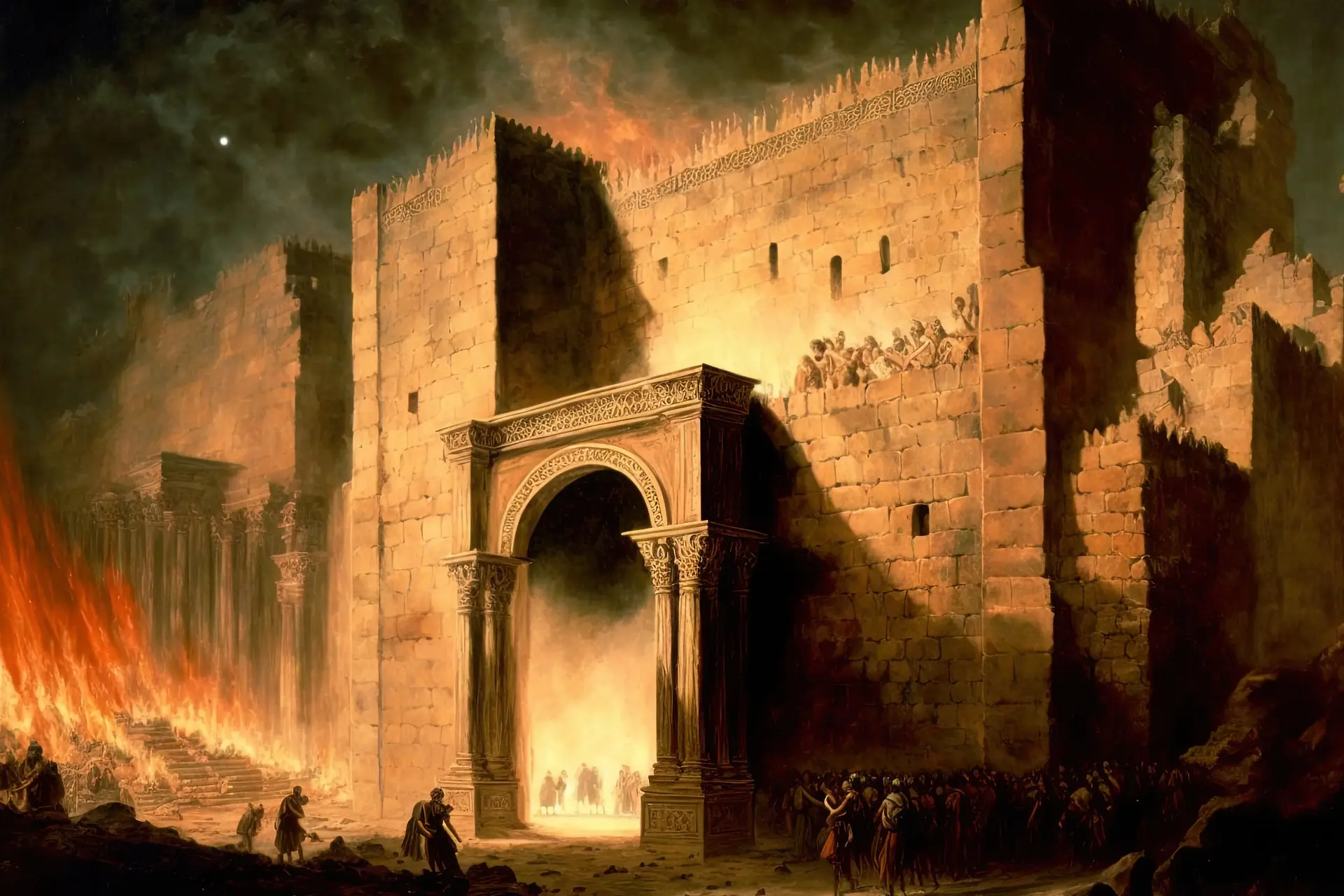
About a month after they seized Jerusalem, on the seventh of Av in the year 586 BCE, the Babylonian troops, led by the general Nebuzaradan, breached the Temple. The wicked Babylonians desecrated the holy place, wreaked havoc, and mocked the sacred items of Israel. In the afternoon of the ninth of Av, the accursed ones set fire to the House of God, and throughout the entire day, the flames consumed the Sanctuary and the Temple.
Second Temple Destruction
The Second Temple stood in its glory for 420 years until it too was destroyed on the ninth of Av in the year 70 CE. According to tradition, the destruction of the Temple came primarily as a punishment for improper behavior between individuals, internal disputes, baseless hatred, and divisiveness.
After breaching the fortified walls of Jerusalem on the seventeenth of Tammuz, the Roman forces embarked on a campaign of destruction and devastation. On the ninth of Av, they destroyed the Sanctuary and the Temple.
Betar’s Capture
Betar was an important city strategically located in the mountains of Judah, situated along the road to Jerusalem. Decades after the occupation of Jerusalem and the destruction of the Second Temple, Betar remained a thriving and prosperous city. It served as a central spiritual and scholarly hub and also as a military stronghold that concentrated defense and offensive forces, posing a challenge to the Roman troops.
On the ninth of Av, fifty years after the destruction, due to internal conflicts, the city fell into the hands of tens of thousands of Roman soldiers who stormed it with brute force, killing many of its inhabitants.
The Capture of Jerusalem
The Roman army did not settle for the destruction of the Temple and the suppression of the rebellion; they razed the Holy City to the ground, demolishing it completely. The silence of Jerusalem and its transformation into a desolate and abandoned place also occurred on the ninth of Av.
Day of Mourning and Fasting
After the destruction of the First Temple, the prophets established the ninth of Av – the day of destruction – as a national day of mourning to commemorate the tragedy that occurred to the people of Israel. When the Israelites returned from exile and built the Second Temple, the fast was abolished. However, when the Second Temple was also destroyed on the same day, the prophets reinstated the observance, and since then, the ninth of Av has been a day of mourning and weeping for generations, designated as a day of distress and fasting.
The Five Afflictions
The prophets established the ninth of Av as a day of fasting and instituted five restrictions on activities that bring pleasure to the body:
- One should not eat or drink, not even a small amount.
- Bathing for pleasure and enjoyment is prohibited. One may only bathe for basic cleanliness when necessary.
- Anointing or applying any ointments, creams, or cosmetics to the body or any part of it is prohibited.
- Leather footwear, whether whole or partial, should not be worn. Rubber, fabric, Crocs, or similar materials are allowed.
- Physical intimacy between spouses should be avoided.
Preparations for the Fast
In the afternoon, a meal (the first one) is eaten to provide sustenance and gather strength for the fast.
Shortly before the beginning of the fast (which starts before sunset), one washes their hands and eats the “Final Meal” in a solemn atmosphere – sitting on a low seat, with each person eating separately. There is no requirement to recite the “Birkat Hamazon” (Grace After Meals), which is obligatory when eating a meal in a group of three or more.
During this meal, one eats a hard-boiled egg dipped in ashes (prepared from burning a small piece of paper) to symbolize mourning and to leave a bitter taste in the mouth.
After the “Final Meal,” one refrains from eating and drinking and begins the fast.
Mourning Customs
Erev Tish’a B’Av (The Eve of the Ninth of Av)
With the onset of the fast, strict mourning practices are observed until the following day at midday when the mourning and sorrow diminish, and the mourning practices become less severe:
- One should not go for a leisurely stroll or engage in idle chatter to avoid diverting attention from the sense of mourning and sorrow.
- People should not greet each other with the customary greeting of peace.
- One should not sit on a high seat but only on a low stool or cushion.
- Torah study brings joy to the heart. Therefore, on Tish’a B’Av, when mourning the destruction, regular Torah study is suspended. Instead, one studies sad and mournful topics and chapters related to the destruction, calamities, and suffering. Additionally, words of admonition, ethics, and piety that awaken a person’s heart to return to their God are studied.
- No work should be done on this day. Our sages taught that those who divert their attention from mourning and engage in work on Tish’a B’Av do not find blessings in their work.
In Synagogues:
- As an act of sorrow and humility, the curtain covering the Holy Ark is removed.
- In a sign of grief and mourning, the lighting in synagogues and private homes is dimmed. During the reading of the Book of Lamentations (Megillat Eichah) and the Kinot (dirges), only minimal lighting is provided as necessary for the reading.
- The evening prayer (Arvit), the recitation of Megillat Eichah, and the Kinot are said while sitting on low seats.
Megillat Eichah
The prophet Jeremiah, the prophet of destruction and calamity, was sent by God to warn and admonish the people of Israel due to their deteriorating behavior and their low spiritual and moral state at that time. He foretold them that because of this, they were at risk of bringing destruction upon themselves.
In his own eyes, the prophet Jeremiah witnessed the fulfillment of his prophecy. Until the destruction of the First Temple, during those sad days, he composed a scroll consisting of chapters of lamentation and grief, expressing the concealment of God’s presence, the destruction of Jerusalem, the burning of the house of God, and the exile of the Jews to Babylon. The scroll is called “Megillat Eichah” (Scroll of Lamentations), named after its opening words: “Eichah yashva vadad ha’ir rabati am…” (“How lonely sits the city once full of people…”).
- It is customary to read the Megillah (publicly) on the night of Tish’a B’Av after the evening prayer. Some also read it again on the following day after the morning prayer.
- At the conclusion of the Megillah reading, the verse “Hashiveinu Adonai eilecha v’nashuva chadesh yameinu k’kedem” (“Turn us back to You, O Lord, and we shall return; renew our days as of old”) is recited aloud together.
- After the Megillah reading, the prayer “V’Atah Kadosh” is recited.
The day of 9 Av
- As every morning, upon rising, one washes their hands. However, on this day, the water should only be poured over the fingertips until the point of connection to the palm (unlike other days when handwashing includes the entire hand).
- During the recitation of “Birkot Hashachar” (Morning Blessings), the blessing “She’asah li kol tzorki” (“Who has provided me with all my needs”) is omitted. This blessing was instituted as gratitude to God for providing us with footwear, but on this day, we are not wearing regular footwear.
During the morning prayer (Shacharit):
- Tallit is not worn, and Tefillin are not donned (this is done after midday in the Mincha prayer).
- The penitential prayers (Tachanun) are not recited.
- From the Torah portion of “Va’etchanan,” the sections that address the warning of destruction and exile, which may come as punishment for the sins of the people of Israel, are read. For the Haftarah, a selection from the Book of Jeremiah relating to the destruction is read.
- We conclude the morning prayer after the recitation of “Uva Letzion” (“And to Zion shall come”). The remaining prayers will be completed towards the Mincha prayer.
Kinot
Towards the end of the morning prayer (Shacharit), the “Kinot” are recited. The “Kinot” are a collection of dirges and poems that lament and weep over the destruction of the Holy Temples, the harsh exiles, as well as other national tragedies that occurred in later periods. Among the notable events included are the cruel Crusades in which masses of Jews were massacred for sanctifying God’s name and illustrious and significant communities were destroyed. Additionally, the expulsion from Spain and the accursed deeds of the Inquisition, which subjected Jews to severe torture in its dark dungeons and led to a period of Torah and cultural flourishing in the countries where they settled.
In the Kinot, we mourn the suffering and hardships endured by our people, but we also express hope and faith in a better future that will come with the complete redemption.
Changes in Prayer
- During the recitation of the section “Uva Letzion,” we omit the verse “Ve’ani zot briti…” because this covenant refers to the Torah, and on Tish’a B’Av, we limit our Torah study.
- During the recitation of the Mourner’s Kaddish after the prayer, we omit the request “Titkabel tzeloteihon uve’uteihon dechol beit Yisrael” (freely translated as “May their prayers and requests, the entire House of Israel”). This is because on this day, our prayers and requests do not have the holy merit and acceptance as usual.
During the Mincha prayer:
- Mincha should be started earlier than usual to ensure it is completed before sunset.
- Before the Mincha prayer, we don the tallit and tefillin, recite the sections of “Kriat Shema,” and complete the morning prayer, including “Shir Shel Yom” and “Ein Keloheinu.”
- We remain with the tefillin and tallit until after the Mincha prayer.
- After reciting the passages of the sacrifices and “Ashrei yoshvei veitecha,” we take out the Torah scroll and read from the portion of “Ki Tisa” the verses that begin with “Va’yechal Moshe” describing Moses’ prayer and plea to God for mercy and forgiveness for his people. God teaches Moses the “Thirteen Attributes of Mercy.”
- The person called up to the Torah for the third Aliyah also reads the Haftarah from the Book of Isaiah, which begins with the words “Dirshu Hashem behimatzo” (Seek the Lord when He may be found), addressing the call to return to God and improve one’s actions.
- During the standing prayer, in the blessing of “Boneh Yerushalayim” (Who builds Jerusalem), where we request the rebuilding of Jerusalem, we add a special prayer that begins with the words “Nachem Hashem Elokeinu” (Comfort, O Lord our God), which includes a request to God to console those mourning for Jerusalem and the Holy Temple.
- At the end of the “Shomea Tefilah” blessing, we add the supplication “Aneinu.” In this passage, we ask God to listen to our prayers, accept our fast, and bring us salvation.
- At the conclusion of the repetition of the prayer by the cantor, the present Kohanim bless the congregation with the Priestly Blessing.
- We conclude the prayer with the recitation of “Aleynu Leshabe’ach” and remove the tefillin.
- Those who customarily wear Rabbenu Tam tefillin daily should put them on now after removing the tefillin of Rashi.
On weekdays, the Kohanim do not bless the congregation during the Mincha prayer. The reason for this is that throughout the day, when they eat and drink, the Kohanim may also consume wine or other alcoholic beverages, which renders them ineligible to recite the Priestly Blessing.
However, on a fast day when the Kohanim certainly do not drink, they can raise their hands and bless the congregation.
- On this day, it is advisable to increase acts of charity, as they have the power to bring about the redemption and hasten the construction of the Third Holy Temple.
Conclusion of the Fast
When three stars appear in the sky, we recite the evening prayer (Arvit) as on any regular weekday. Afterwards, we wash our hands (with a full washing, pouring water on both hands) since we did not do so in the morning, and we put on regular shoes.
In the month of Av, we “sanctify” the moon after the fast. The reason for this is that we perform the “Kiddush Levanah” (Sanctification of the Moon) every month with great joy and a large crowd. Due to the absence of joy during the days of mourning for the destruction, we postpone the Kiddush Levanah ceremony for the month of Av until after Tish’a B’Av.
Tish’a B’Av Falling on Shabbat
When the ninth of Av falls on Shabbat, the fast is postponed to Sunday, the tenth of Av.
On Shabbat (the ninth of Av), it is a mitzvah to eat meat and drink wine as usual, and even more than usual. Even during the third meal, which is the final meal of Shabbat, one should finish eating before sunset.
- During the Mincha prayer, we do not recite the “Tachanun” section.
- On Shabbat, we should not prepare the Book of Lamentations (Megillat Eicha), the Kinot book, or the shoes of Tish’a B’Av.
- We eat the midday meal, and towards sunset, we have the “Se’udah Mafseket” (the third meal), recite the “Birkat Hamazon” (Grace After Meals), and wait at home until the departure of Shabbat.
- We say the blessing “Baruch Hamavdil bein kodesh lechol” (Blessed are You, Who distinguishes between the holy and the secular) and bless over the Havdalah candle with the blessing “Baruch Atah… borei me’orei ha’eish” (Blessed are You, Who creates the lights of fire). We do not recite the evening blessing over spices (besamim), and we do not recite the verses of “Vayiten Lecha” during Havdalah.
- We change into Tish’a B’Av shoes and bring the Book of Lamentations, Kinot, and similar texts to the synagogue.
- On Sunday evening, at the conclusion of the fast, we recite Havdalah with the usual text, bless over a cup of wine (without the blessings over spices and fire), and drink the wine as usual.
- At this time, immediately after the fast, it is permitted to shave, wash, listen to music, and recite the “Shehecheyanu” blessing.
The 10 Av
The burning of the Temple began on the eve of the ninth of Av, and the flames consumed the Temple during the following day. Therefore, even on the tenth of Av (until midday), we continue to observe the mourning customs practiced during the Nine Days.


