








Introduction
A Jewish home is not just one in which a person born to a Jewish mother resides or one who converts according to Jewish law, but rather a home with certain elements that create its “Jewishness” beyond its internal functioning.
Here are some key identifying signs summarized here briefly, and we will expand on some of them later in the booklet.
- It is important to note that beyond the external signs, the most important thing is how you conduct yourselves within it: observing the commandments, studying Torah, mutual respect, love for others, and more. However, those “Jewish” elements do not necessarily exist from the outset, just like the infrastructure of water and electricity. Therefore, most things can be done without any problem even after the house is built and standing.
Mezuzah
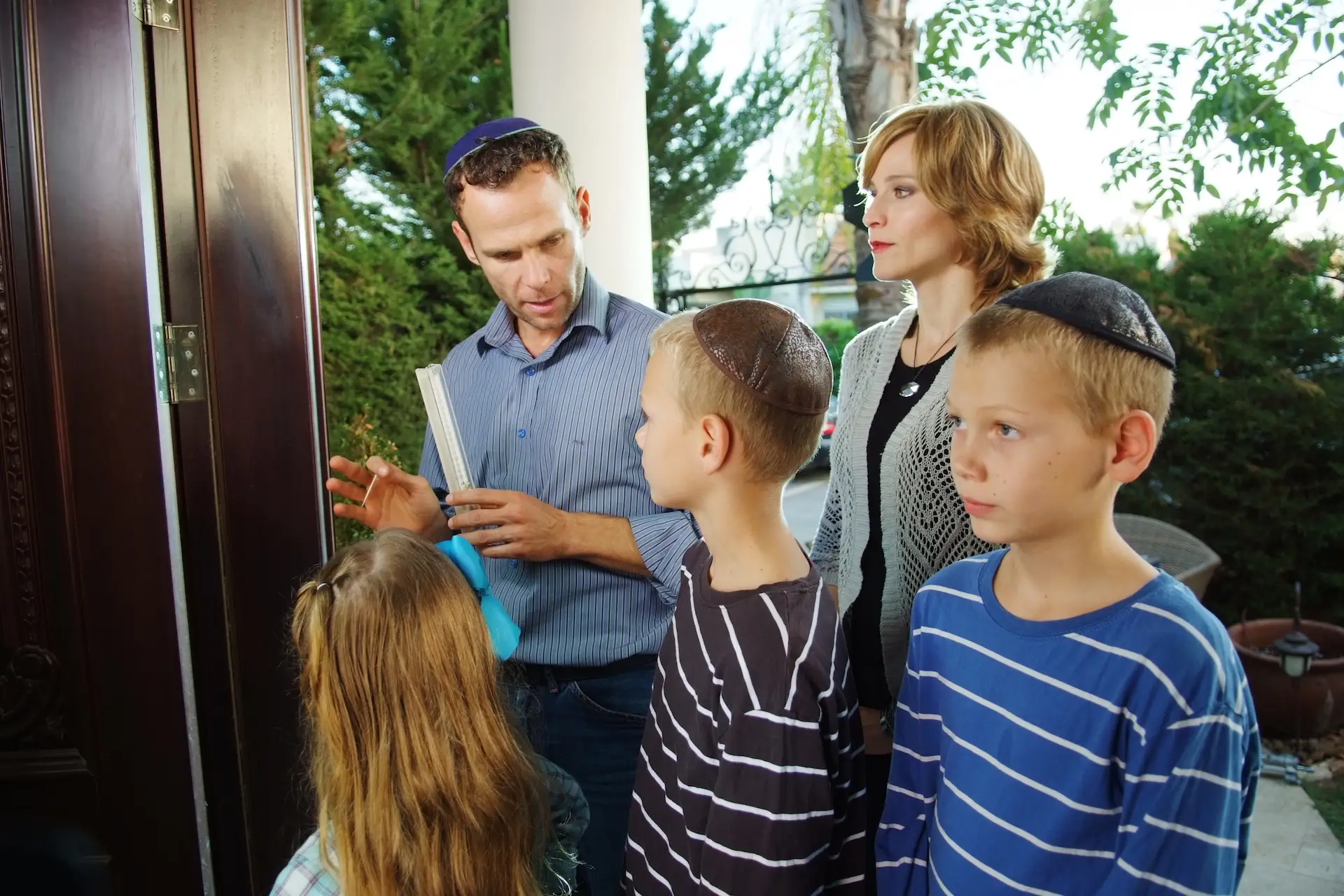
Already from the outside, we can identify if we are standing in the threshold of a Jewish home. Even before entering the house, we encounter the “guardian” – the mezuzah on the doorpost, which generally testifies silently to the Jewish presence beyond its threshold. For more details about the mitzvah of the mezuzah, see page 30.
Charity Box
One of the important commandments in the Torah is giving “tzedakah” – giving money, food, clothing, or anything else that the other person needs. Due to the importance of this mitzvah, one should strive to give tzedakah every day. However, since we cannot always “chase” after those in need, and on the other hand, the most available option for giving tzedakah is through money, the “tzedakah box” was created for this purpose: a box designated to store the money we dedicate to giving tzedakah until we have the opportunity to bring its contents to the needy or to another charitable cause close to our hearts.
- It is highly recommended that every home has a “charity box,” and one should strive to put a coin in it every weekday.
- It is advisable to place the charity box on one of the walls of the house (preferably in the kitchen) – thus, the physical house itself becomes a “house of charity,” adding blessing to the entire home.
Our second home is the car, and it is also advisable to place a charity box in it as a protection against road accidents, and before every trip, to put a coin in the charity box. It is also recommended to have a Chumash book in the car, which includes the Five Books of Moses, Psalms, and Tanya (a book of Chassidic teachings) as a segulah for protection.
Holy Books
Just as every kitchen has cookbooks, so too in every Jewish home, there must be holy books. The mere presence of these books in the home – even without studying them – brings holiness and blessing. One of the prominent features of the Jewish home throughout generations is a “house full of books” – complete cabinets of holy books befitting the “People of the Book,” which create a sense of Jewish warmth in the home and fill it with the light of sanctity. And as with any subject, the most important are the foundational books in this field, so in a Jewish home, the first thing is to make sure that there is the foundational book of Judaism: the Tanakh (comprising the Five Books of Moses, Prophets, and Writings). Furthermore, it is important to have books related to our daily Jewish lives, such as a prayer book, Psalms, and Shulchan Aruch (the Code of Jewish Law that encompasses all the laws a Jew needs to know and practice). Additionally, books that address Jewish perspectives, such as the “Tanya” – the foundational book of Chabad Chassidic teachings, and others, are also valuable.
The Kitchen
One of the prominent identifying signs in the kitchen of a Jewish home is the separation between the meat and dairy areas. The Torah prohibits us from eating, cooking, or deriving benefit from a mixture of meat and dairy; therefore, we make every effort to avoid any mixing between the two.
Even the utensils we eat with should be separate for meat and dairy, as they absorb the heat from the hot foods we eat, so it is impossible to use them with both dairy and meat dishes.
The subject of koshering the kitchen is a topic on its own, which we will expand on later, on The Jewish Kitchen.
- As mentioned before, it is recommended to have a fixed charity box on the kitchen wall, where you can put a coin in it every weekday.
Children’s Room
The children’s room, as the place where they spend a significant amount of time during the day and night, should also be equipped with “Jewish“ items, such as a charity box and holy books. These items will constantly remind them of the existence of the Creator of the world and His commandments and will undoubtedly have a positive impact on them.
- It is recommended that each child has their own charity box, prayer book (there are colorful and illustrated prayer books suitable for children), and their own Chumash, with their first name written on them. This way, they will be motivated to give charity in their personal box and to read, learn, and pray from their own books, creating a more meaningful connection for them.
- It is advisable to fix the mezuzah on the entrance of the children’s room at a slightly lower height (according to the laws of halacha) to allow the children to reach it and kiss it every time they enter the room, especially before sleep.
Paintings and Pictures
People invest a lot in home design, choosing different elements to create a unique atmosphere in their home. A significant part of the design is the decoration of the home’s walls with beautiful pictures or paintings, and it is important to pay attention and ensure that at least some of them are related to the world of Judaism (“Home Blessing”, a painting of Jerusalem, a picture of a righteous person, and so on).
If you recall for a moment the house in which you grew up as children, you are almost certain to remember well what stared at you from the walls. Daily viewing over decades greatly affects the soul, and it is fitting to think well about which pictures and paintings we introduce into our own ‘personal museum’.
Remembrance of the Temple’s destruction
There are some ‘sad’ customs that we perform since the destruction of the Holy Temple, known as “remembrance of the destruction”. We mainly encounter them at moments of great joy, when we want to remind ourselves that our joy cannot be complete as long as the Temple is destroyed. The example we all probably know is the ‘breaking of the glass’ under the wedding canopy.
So too, when we build a house and rejoice in its construction, we usually leave one spot in the house unplastered, a “remembrance of the destruction”, a space measuring 50x50cm facing the entrance. This place will remind us (essentially by its incomplete construction) that the full redemption has not yet arrived. We are still missing something.
Railing
The Torah does not refer to the external construction method of our house (architecture, interior design, and the like), but it has a clear statement on safety. In the Book of Deuteronomy, it says, “When you build a new house – make a railing for your roof.”
The house we live in must be safe, and we need to make sure there are no potential hazards. If we have access to the roof area, we are obligated to install a railing there at least 80cm high (ten hands’ breadth), and by doing so we fulfill a commandment from the Torah.
- Do you have a private pool at home? Make sure you have a good, dense, and high enough fence around the pool to prevent small children from falling in or an unexpected fall by anyone else.
The Torah indeed speaks of a physical railing, but the same idea exists in other things that can cause harm, and we are also obligated to make a ‘railing’ – to do everything in our power to prevent people from getting hurt by them. For example: Place kitchen knives relatively high to prevent children from freely accessing them.
- Do you have a licensed gun? Here too, you should make a ‘railing’: keep it in a secure place, with the magazine separately.
Just as in the physical dimension, so too in the spiritual one: when there is a potential spiritual danger at home, such as: open internet, which entails many dangers, you must make a ‘railing’ – install a protection that does not allow access to undesirable content throughout the virtual network.


