








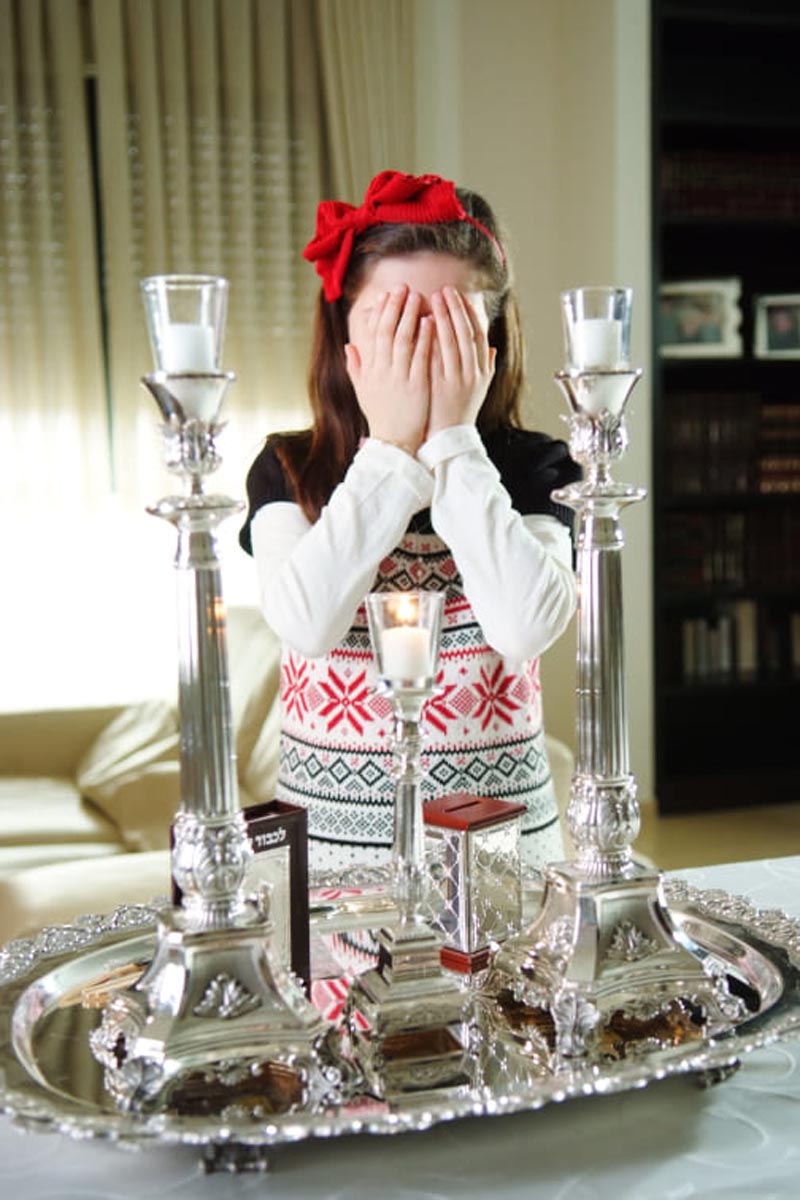

Candle Lighting
Our Sages required every woman to light a candle in her home on every Shabbat or holiday. The purpose of this requirement is to honor the sacred day and to ensure that the home will be properly illuminated and that there will be an atmosphere of comfort and tranquility.
- Before lighting the candles, a woman should recite the Minchah prayers and place a coin in a charity box.
- A single girl should begin lighting one candle at the age at which she learns to speak. She should continue this practice until her marriage.
- A married woman lights two candles, plus one additional candle for each of her children.
- After the candles have been lit, the woman should place her hands over her eyes and recite the blessing, “Blessed are You, G-d, our L-rd, King of the universe, Who has sanctified us with His commandments and commanded us to light the candle of the holy Shabbat.”
The Minchah Service
Korbanot are recited at Minchah, but we do not recite Psalm 107, which is usually recited on Friday afternoons. Instead, we recite only “Patach Eliyahu–Elijah began” and Yedid Nefesh.
- It is important to remember to recite Yaaleh V’Yavo in the Shemoneh Esrei prayer.
The regular Minchah service of Shabbat is recited, and the Torah reading is drawn from the weekly Torah portion. Yaaleh V’Yavo is added to the Shemoneh Esrei, and Psalm 27 is recited before Aleinu.
Kabbalat Shabbat
The service begins with Psalm 29. Psalms 95 through 99, which generally precede Psalm 29 at Kabbalat Shabbat, are omitted. During the final stanza of Lecha Dodi, the text is slightly altered, as we recite, “bo’i b’simchah u’v’tzahalah— come with joy and gladness.”
The usual Maariv service for Shabbat is recited, with the addition of Yaaleh V’Yavo in the Shemoneh Esrei. We then recite the passages of Vayechulu, Magen Avot, and Psalm 23, as on every Friday night.
Maariv concludes with Barchu and Aleinu.
The Friday Night Meal
Upon returning home, it is customary to greet one’s family members with the traditional greetings of Shabbat Shalom and Chag Sameach and then to enter the sukkah.
The passages at the beginning of the Friday night meal, Shalom Aleicheim and Eishet Chayil (Woman of Valor) should be recited in a whisper.
The head of the household recites the usual Kiddush for Shabbat, concluding it with the blessing for sitting in the sukkah.
The family then proceeds to wash their hands and recite the blessing of Hamotzi over two uncut loaves of challah.
- A man who did not recite Kiddush on his own, as well as women and children, should recite the blessing over sitting in the sukkah after the blessing on bread, but before taking a bite.
The following additions are made in the Grace After Meals:
- Retzeh, the passage generally added for Shabbat
- Yaaleh V’Yavo
- The line beginning with Harachaman (“the Merciful One”) for Shabbat
- The line beginning with Harachaman (“the Merciful One”) for Sukkot: “May the Merciful One rebuild for us the fallen sukkah of David.”
One should endeavor to increase one’s joy on the Shabbat of Chol Hamoed Sukkot by drinking wine, singing, and dancing in commemoration of the simchat beit hashoevah celebrations.
Shabbat Morning
After the morning blessings, the Four Species are not taken. They are also not brought to the synagogue on Shabbat.
The Shacharit and Mussaf Services
The prayer services begin like those of any Shabbat, with Korbanot, Hodu, Pesukei Dezimrah, and the Shema and its blessings. Yaaleh V’Yavo is inserted in the Shemoneh Esrei of Shabbat, and the Whole Hallel is recited, without the Four Species being held. Hoshanot are not recited on Shabbat. The Song of the Day and Psalm 27 are recited, and we continue with the Torah reading.
For the Torah reading, two Torah scrolls are removed from the Ark. Seven honorees are called up to read from the first scroll. The portion of the Torah that is read is a selection from the Torah portion Ki Tisa that deals with the giving of the Two Tablets to Moses and goes on to discuss the Three Festivals. A single honoree is called up to read the Maftir portion from the second scroll; the Maftir is taken from the Torah portion of Pinchas and discusses the sacrificial offerings of the festival.
After Hagbahah has been performed on the second scroll, the person who received Maftir recites a blessing over the Haftarah and reads the Haftarah aloud. The Haftarah for this Shabbat is taken from the Book of Ezekiel and describes the war of Gog and Magog.
After the Haftarah, the honoree recites the concluding blessings over the Haftarah. In the final blessing, “For the Torah and for the service,” he concludes with the words, “Blessed are You, G-d, Who sanctifies the Shabbat, Israel, and the festivals.”
The Torah reading is followed by Yekum Purkan and Ashrei. We then recite the Shemoneh Esrei of Mussaf of the Three Festivals, adding in the portions that are relevant to Sukkot. This is followed by Aleinu, and the prayer service concludes with the Six Remembrances, the passage of “You shall take fine flour” (which is recited every Shabbat), and the daily recitation of Psalms.
The Shabbat Meal
Psalm 23 and the other passages that appear in the siddur are recited in a whisper. The blessing over the wine should be recited aloud, and Kiddush concludes with the blessing recited over sitting in the sukkah.
This is followed by Netilat Yadayim and a blessing over two uncut loaves of challah, followed by the rest of the meal.
- A person who did not recite Kiddush must recite the blessing over sitting in the sukkah after the blessing on bread, before he partakes of the bread.
The same four insertions that were made at the nighttime Grace After Meals are added after the daytime meal.
The Maariv Service
We recite the Maariv prayers as on any Motzaei Shabbat, adding the passages of Atah Chonantanu and Yaaleh V’Yavo during the Shemoneh Esrei.
The passages of Viyehi Noam and V’Atah Kadosh are not recited after the Shemoneh Esrei of this Maariv, since the holiday of Simchat Torah will occur during the coming week. These passages are always omitted when a holiday will begin before the following Shabbat.
The Maariv service concludes with Aleinu.
Havdalah
Havdalah is recited as on any Motzaei Shabbat. One should remember to recite it in the sukkah.
Havdalah begins with “Hinei E-l yeshuati—Behold, G-d is my Savior,” followed by the blessings over the wine, the fragrant herbs, and the flame. Havdalah concludes with the blessing over sitting in the sukkah.


