











Background
An ancient Jewish custom practiced in many communities is to give a child his first haircut at the age of 3 years. This haircut is also known as ‘chalakah’ (haircut in Arabic).
During the first three years of the child’s life, not even a little bit of his hair is cut. On his third birthday (according to the Hebrew calendar, of course), family members and close friends gather and cut the child’s hair with scissors. On this day, the baby, who has already become a child, is shorn and a little bit of hair is left on both sides of the head (the ‘pe’ah’ above the level of the ears). These hairs are called ‘payot’ (sidelocks).
This ceremony was practiced in many communities throughout Jewish history, and accepted in Israel’s Diaspora, it is not obligatory according to Jewish law. Its spiritual impact on the child’s soul is great, and therefore it is highly recommended to observe it.
- If his third birthday falls on times when it is not permitted to cut hair, such as on Shabbat and holidays, during the Counting of the Omer, etc., the haircut should be postponed to the first available opportunity.
Haircut Day
- On the day of the haircut celebration, all family members add to the great joy, and everyone wears festive clothes.
- During the day, all friends and the extended family are invited to participate in the joy and this meal is called a ‘seudat mitzvah’ (a meal in honor of the fulfillment of a commandment).
- In the morning, it is recommended to take the child to receive a blessing from the Rabbi and also to honor the Rabbi to be the first one to cut the child’s hair.
The ‘Kippah’ (skullcap)
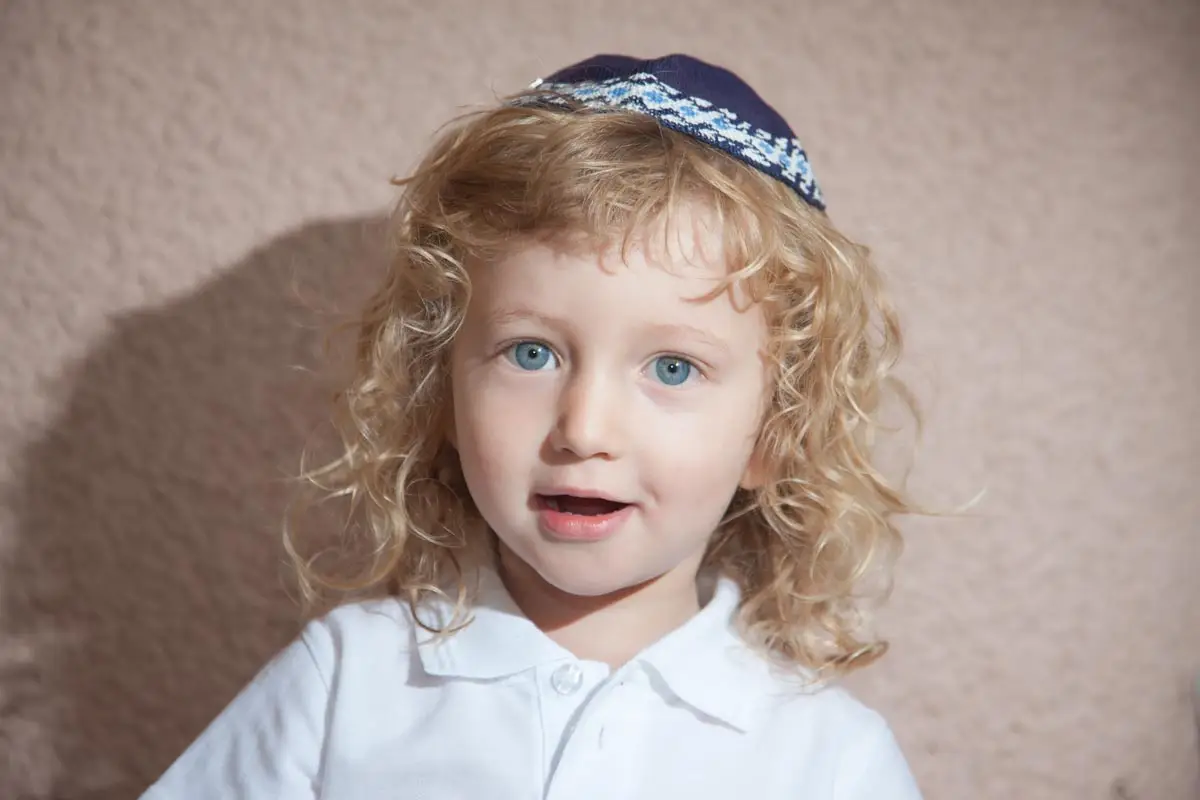
From the day of the haircut onward, the child should wear a ‘kippah’. The idea behind it is to give the wearer the feeling that there is always something above him. God’s watchful eyes are always on every Jew, and everyone should behave accordingly. Moreover, this feeling also gives on the other hand a sense of greater security knowing that someone is always watching over him from above and ‘looking after his interests’.
Haircut Ceremony
In preparation for the haircut, you should arrange in advance:
- A kippah and a ‘small tallit’ (tzitzit) for the child.
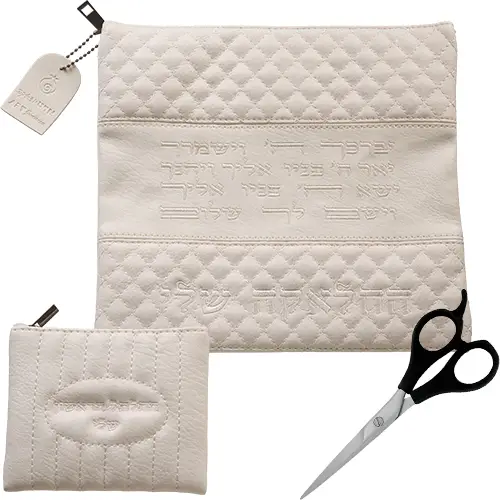
- Scissors for cutting the hair, (make sure they are the kind that will cut well so they won’t hurt the child).
- A bag to place the hair in.
- A charity box and coins.
- Refreshments for the participants.
- If you choose to observe this custom, it is advisable to prepare and talk with the child, so he won’t be scared of the scissors and the crowd that will come to celebrate with him, and cut his hair.
Why do we have a hair cutting ceremony?
At the age of 3, the child progresses another step in his physical and emotional development. This is the age when Judaism imposes on his parents to begin the first steps of his Jewish education. This beginning is the observance of the Torah prohibition of cutting the corners of the head. Therefore, at this event (and it is also advisable afterwards), we dress the ‘groom’ in a kippah and a small tallit and begin to educate him in giving charity.
The Celebration
Once they reach the age of three, one should start instilling Jewish customs in them. Thus, for the upcoming haircut celebration, dress the child in festive clothes, place a yarmulke on his head and dress him in a ‘small tallit’ (tzitzit).
Many people travel to the Meron settlement in the north, in order to hold the celebration next to the grave of Rabbi Shimon bar Yochai – as a continuation of an ancient tradition to hold the haircut celebration next to his grave. Some choose to celebrate next to the grave of another righteous person or at the Western Wall – when living far from Meron. But in practice, you can hold it wherever you choose: at home, in the neighborhood synagogue, in a hall, and anywhere else.
How is the haircut done?
For the haircut, it is preferable to first honor a spiritual figure (such as a rabbi, etc.) or the child’s father, then honor a Cohen or Levi if they are present at the event, and then the rest of the attendees. It is worthwhile to ensure that everyone cuts a little, so that there is enough left for those who follow…
The participants bless the child’s parents and wish them to raise him in health and Jewish pride.
- Take care not to cut the hair on the sides of the head so that it is possible to later ‘shape’ them into ‘sidelocks’ (with a bit of hair).
During the ceremony, it is desirable for the child to put a coin in the charity box, this way we begin to educate him in giving. It is beneficial if possible to put coins that also the participants can put a coin in the charity box for the child’s merit.
Why don’t we celebrate a haircut for a girl?
The divine commandment that forbids cutting the sidelocks of the head applies only to males, therefore the custom of the first haircut does not apply to daughters. However, many organize a ceremony the first time the daughter lights Shabbat candles (even though lighting candles is not related to age but to the time when the child begins to speak and can say the blessing over lighting the candles).
Learning the letters
Unlike any other language, the letters of the Hebrew language have holiness and meaning. Every letter has a reason why it looks this way and not another. The reason for this is that these letters were not invented by humans (who sought signs for every utterance and sound) like all the letters in the world, but we received them from God, in His holy Torah.
Therefore, it is very advisable to start teaching the child the ‘alef-bet’ letters of Hebrew from the age of 3 – as part of the beginning of his Jewish education, also the sanctity within them has an impact on his personality and development.
A nice custom is when you start teaching the child letters, do it from a holy book, like the Bible and similar – this way added holiness and spiritual influence while he learns the letters.
Why should we grow sidelocks?
There are several commandments in Judaism that are intended for one thing: to distinguish us from the nations around us. The more we refrain from adopting their customs and their ways of life, the more we distinguish ourselves from them and keep more of our Judaism and our commandments.
This is one of the reasons for not cutting the sidelocks: in the past, the custom of the nations of the world was to cut the sidelocks of the head. In order to differentiate from them, God forbade us from doing so.


