








Flower Decorations
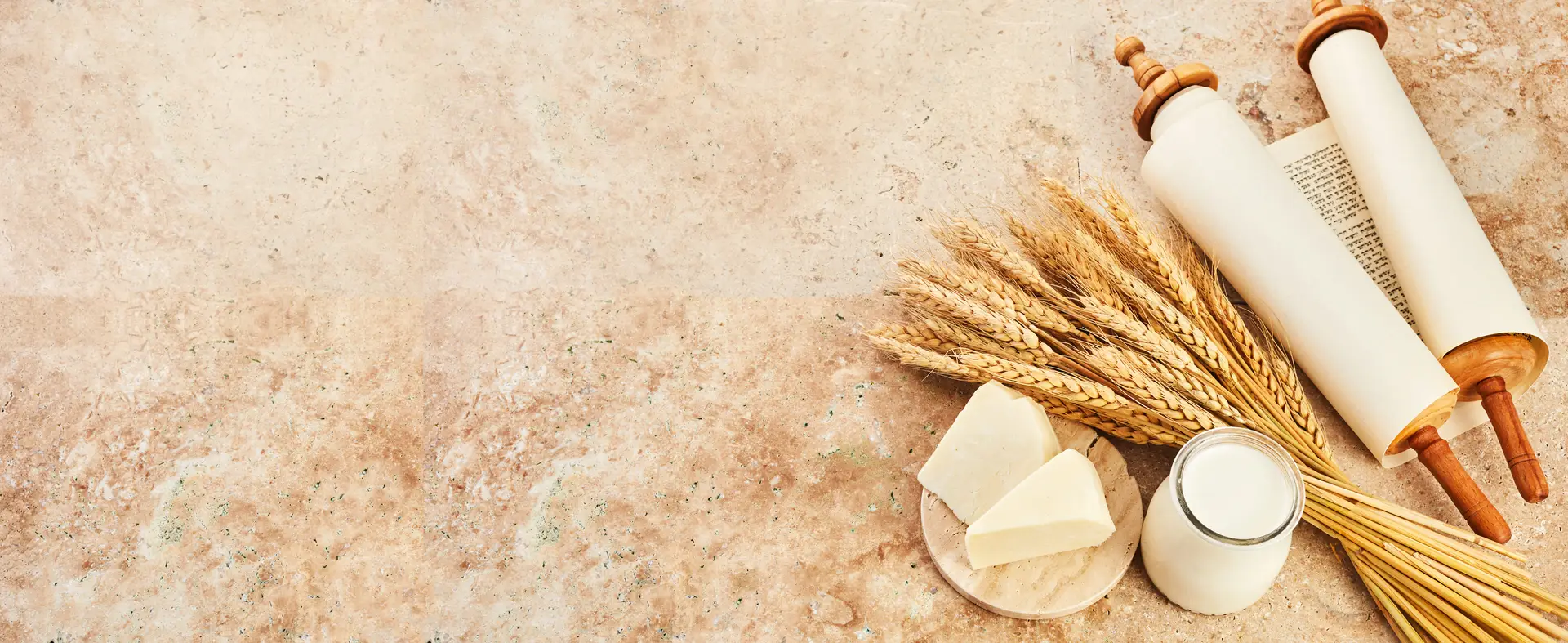
As Shavuot is a harvest festival, some have the custom to decorate the house and the synagogue with flowers and fruits. Another reason for this is what our sages told us, that in anticipation of the giving of the Torah, Mount Sinai – which was a desolate mountain until the giving of the Torah – was covered with grass, trees, and green blooming.
It is important to finish arranging the flowers on the eve of the holiday, to maintain the sanctity of the festival.
Hearing the Ten Commandments
On the day of Shavuot, the people of Israel received the Torah on Mount Sinai, more than 3,000 years ago. Since then and until today, on this day in the synagogues, we read from the Torah scroll the description of the Sinai event and the receiving of the “Ten Commandments”. Our sages said that hearing the “Ten Commandments” on Shavuot is considered as if we are hearing them from God Himself, as it was at the time of Mount Sinai.
Care should be taken that every Jew – men, women, boys, girls, and even small infants who have just been born – should be in the synagogue at the time of reading the “Ten Commandments”. The Lubavitcher Rebbe explained this custom by saying that all Jews – without exception – were present, either in body or in spirit, at the time of receiving the Torah at Mount Sinai.
The children have a special privilege, because only in their merit was the Torah given to the people of Israel – when our fathers promised God that the children would be “guarantors” for the continuation of the Torah to the following generations.
In many synagogues, they organize a special “Reading of the Torah” in the afternoon for women and children who could not come in the morning for the Shacharit prayer.
The Book of Ruth
In many communities, it is customary to read the “Book of Ruth” during the holiday, which describes the story of Ruth, a Moabite convert who joined the Jewish people.
Ruth’s story is connected to the holiday of Shavuot for several reasons:
- Shavuot is the birthday and day of death of King David, who is a direct descendant of Ruth and her husband Boaz.
- The harvesting events described in the Book of Ruth correspond with Shavuot – the holiday of the harvest.
- Ruth was a convert who wholeheartedly accepted the laws of the Torah. On Shavuot, we are all considered, in a certain sense, ‘converts’, receiving the yoke of the Torah anew, and with joy.
Eating Dairy Foods
Shavuot is also famous because it is customary to eat dairy foods.
There are many reasons to interpret this ‘tasty’ custom, here are two of them, “on the tip of the fork”:
- At the event of “Giving of the Torah”, the Jewish people were given the laws of “Kashrut”. Since the Torah was given on Shabbat, it was not possible to slaughter animals for food – as required by the ‘new law’, and therefore the people made do with dairy products.
- King Solomon likened the Torah to milk, and the meaning of the allegory is: Just as milk nourishes the body – so too does the Torah provide the spiritual nutrition needed for the human soul.


