







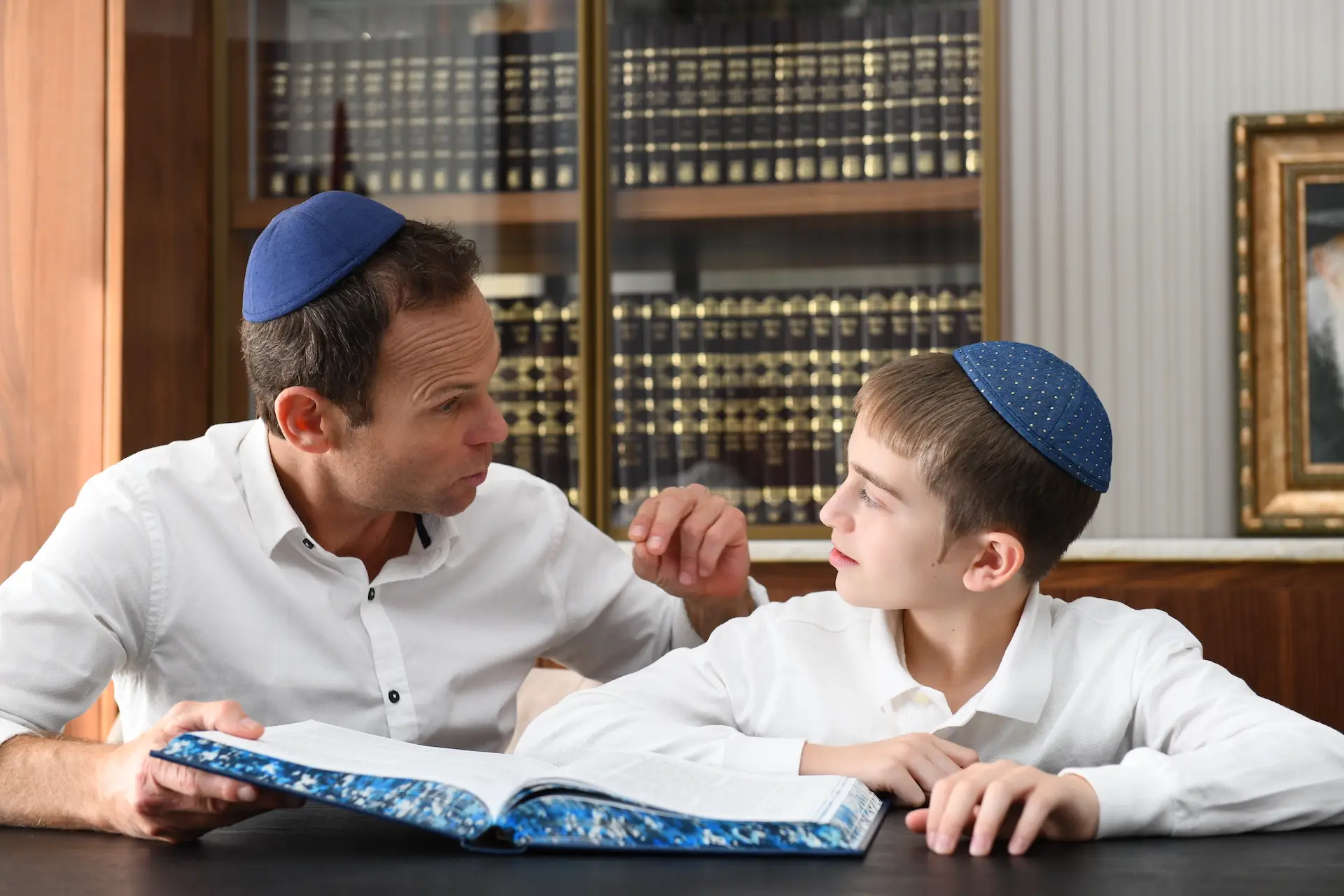

Education: Our Mission
Educating our children is the most important topic: it will determine the future; it will shape the destiny of the next generation; it, and nothing else, will shape the character of the Jewish people in the coming years.
Many challenges face our generation. Being Jewish in the modern world is not a simple task, to educate the next generation to walk in the ways of the forefathers when electronic devices are an integral part of our lives, this is a challenge that has never been in the history of the Jewish people.
True education is where we teach our child not only how to behave but also how to think, how to feel, and how to know. For example: education in which the child not only performs tasks by accepting the yoke (because Dad said) but also understands their meaning and therefore fulfills them with love and awe.
What is education?
In schools, there are teachers and educators. The title ‘educator’ is given to someone who has been assigned responsibility for a particular class and usually teaches them for most of the school hours, while we give the title ‘teacher’ to someone who comes to teach a specific profession in the class.
Both the teacher and the educator need to show care for every boy and girl, but while the teacher’s goal is to well transmit the learned material, and no more, the role of the educator is much beyond transmitting ‘dry’ information. A true educator should know the soul of the child, his weaknesses and talents. Develop the positive sides in him and bring them into action, and simultaneously deal with his weak points. Not to ignore them and also not to surrender to them. And the main thing: to do all this from dedication and endless love.
Each and every one of us has different memories from school, there is a figure that is etched in our consciousness, a figure of a beloved and devoted educator, who ‘gave himself’ for our sake and instilled something in us. This is a teacher for life.
We are the educators
With all due respect to the school (and there is respect…), the main burden of education falls on us, the parents. Children’s education begins at home and ends at home. The parents, and again the parents, are those who have been entrusted with the most valuable task: educating the children.
We just need to make sure we don’t become like that ‘teacher’ who only teaches the child how to walk, but doesn’t explain where to… who only teaches the child how to eat, but doesn’t care to instill in his heart gratitude to the one who provided him with food.
Moreover, ‘to educate’ is not just to teach the child what is the right and correct way in life, but also to care and accustom him to walk in it. And if we’re talking about Jewish education: it’s not enough just to teach the child about Jewish concepts and introduce him to Jewish ‘folklore’. We need to ensure that the child connects to Judaism, to the Torah and its commandments in a personal way, and to accustom him to behave accordingly.
Question : What age in education is the most significant?
Answer: “Man is the tree of the field”, the child is like a tender sapling, the smaller it is, the easier it is to straighten it. So too with the child: the younger he is, the easier it is to guide, educate and ‘straighten’ him. However, education never ends. Every age has its challenges. Every age has its difficulties. Our parents are here for us, and we are here for our children…
Daily Task
If education was just about transferring information between us and our children, it would be enough to do it from time to time. But education is much more than a monthly or weekly task. It is a constant task that needs to be at the forefront of our minds all the time.
Education surrounds us 24 hours a day, but at the same time, there is a time when we need to dedicate time to setting goals, learning lessons, and summarizing the events of the day:
“Just as the laying of tefillin is a Torah commandment for every Jew… so it is an absolute duty for every Jew to dedicate half an hour each day to thinking about the education of his children, and to do everything in his power… to influence his children to walk in the way they are guided.” (Rabbi Yosef Yitzchak of Lubavitch)
In addition to this, parents must dedicate noticeable time each day to thinking about their children and their education, and do everything they can to ensure and act so that they are educated in the right way.
Education is also expressed in the fact that the child feels that we care about him. We need to always have our finger on the pulse, to hear from him on a daily basis what happened to him at school, to listen to what he tells, and especially to what is hidden between the lines. This is also expressed in sitting down with the child to review the learned material, and occasionally making contact with the teacher to get another perspective on our beloved child.
- In Jewish sources, we find that the one who is obligated to deal with the education of the children is primarily the father, but today the commandment of education falls on both the father and the mother. On the contrary, in most homes, the mother is the one who is with the children most hours of the day, and therefore she has an extra responsibility.
Personal Example
Even if all the trees were pens and all the heavens were parchment scrolls and on them were written all the education methods that exist in our world and we knew all of them by heart, straight and upside down – we would not succeed like the power of education hidden in the personal example.
Imagine a university lecturer explaining to students in good taste for a long hour about the disadvantages of smoking. How harmful it is, how polluting it is, and how much one should avoid it. All this accompanied by presentations and video clips that demonstrate beyond any doubt the severe damage that smoking causes to the smoker and those around him.
At the end of the lecture, when everyone is under its strong impression, the lecturer takes out a cigarette, and in the most natural way lights it, takes a deep puff into his lungs, and emits rings of white smoke into the air…
This is the heart of education.
When the father behaves according to the values he wants to educate his son, the child absorbs the things, internalizes them and he too will usually want to behave this way. How would we like things to be arranged in the small head of the child if he sees his parents behaving exactly the opposite of what they ‘preach’ to him all day?
They tell about a man who came to a rabbi with a one-year-old baby.
– “When should I start educating him?” the man asked.
– “You should have started two years ago,” the rabbi replied…
Age of Education
The sages command to educate the sons in the way of the commandments, so that when they grow up and reach the age of commandments they can immediately fulfill all the relevant commandments out of the 613 commandments.
The education period is divided into three:
- From birth to about the age of six.
- Age of Education’ – age six to Bar Mitzvah.
- Age of Bar Mitzvah to the age of majority.
In the first period, the child is still young. He needs to be educated in basic things like cleanliness, modesty, manners, restraint, and the like.
In the second period, the child has already grown a bit, it is already possible to instill in him the right attitude to study, conduct and manners – honoring parents, discipline, and the like.
In the third period, from the age of Bar Mitzvah – education should already be of higher quality.
We should pay attention to what to educate the child at each age so as not to harm him, God forbid.
Question : The children are small, and what does it matter what exactly they will eat and what they will do?
Answer : On the contrary. Because they are small and their soul is soft and delicate, the influence of things on them is stronger. Therefore, we must protect them from forbidden things and accustom them to good things.


