








What is kosher and what is not?
The Torah gives us clear rules about the food we can eat.
Animals are generally divided into 4 types: mammals, birds, fish, and invertebrates.
Since in our time, we buy most of the meat, poultry, and fish, after all the processes, when they are ready to eat, we need to make sure that a kosher stamp is embedded on the food packaging. In Israel, for example, most live products undergo minimal scrutiny by kosher inspectors to ensure that the meat comes from a kosher source.
Mammals
The Torah gives us 2 signs of kashrut so that we know whether any beast or animal is kosher for eating:
- A “ruminant” animal: if the stomach structure and digestive system of the animal are built in such a way that it returns a second time to the oral cavity for further chewing.
- An animal with “cloven hooves”: if the animal’s footpads are split and divided into two, and each hoof looks like a pair.
Only if we discern both of these characteristics together in an animal or beast – then we can certainly say that it is kosher for eating (of course, after slaughtering and koshering the meat – a subject on which you can read more on page 69).
- Not only are impure animals themselves prohibited, but also what comes out of an impure animal, such as milk milked from an impure animal – is forbidden to drink.
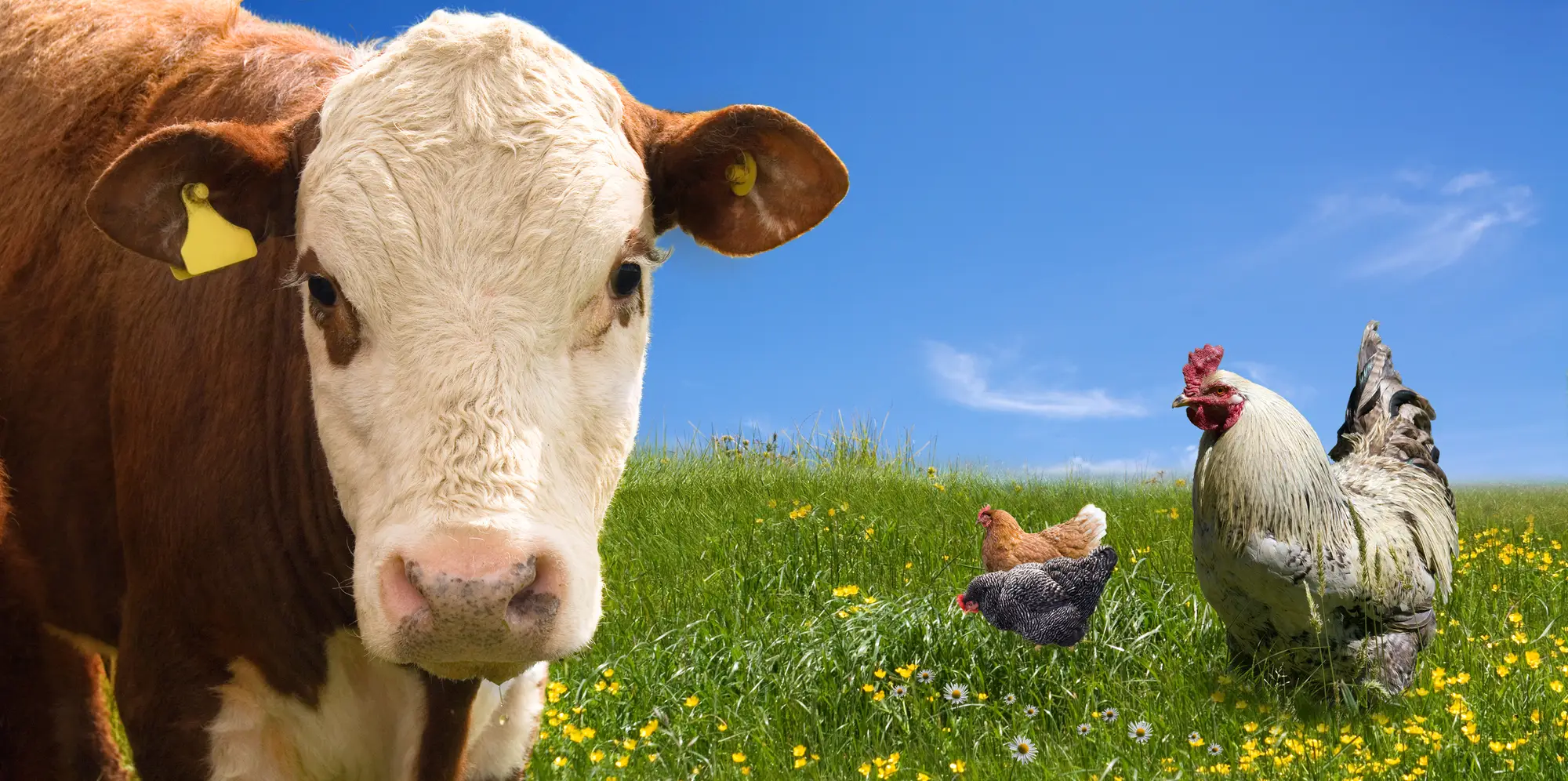
Examples of kosher animals: cow, sheep, goat, deer, gazelle, and more.
Examples of non-kosher animals: pig, hare, bear, dog, monkey, camel, horse, and more.
Why were these two signs chosen?
These two signs mainly appear in a ‘vegetarian’ animal, which is not a predator:
The cloven hoof is needed for an animal that needs to defend itself from predators and needs to flee. It helps it to hold on to the ground well and be prepared to run away.
Also, rumination symbolizes the ‘vegetarianism’ of the animal. When it finds its food, it quickly puts all of it into its mouth – for fear that a predator will come and tear it or steal its food – and at a calmer opportunity, in a safe place, it raises the food back to its mouth for further chewing and grinding.
We do not want to put into us food that comes from predatory animals, so as not to absorb predatory characteristics. Therefore, it is permitted to eat these beasts that do not have predatory characteristics and will not influence us afterward…
However, it is important to emphasize that we eat kosher because God so desires. And like any commandment, when we are careful to fulfill it, we connect with God and become tied to Him.
How to do Shechita?
You have probably asked yourself more than once what is so complex about the kosher status of meat? Let’s take a peek at the amount of details and tasks that the slaughterhouse team of shochtim (ritual slaughterers), kosher supervisors, and all the workers have to undertake:
How is slaughtering done?
Shechita is the process of killing an animal in order to prepare it as meat for human consumption. This procedure is mostly carried out in slaughterhouses by shochtim (ritual slaughterers) and butchers, using various techniques, which depend on the type of animal, country laws, and halachic (Jewish law) guidelines.
Shechita according to Halacha is performed by severing the neck of the animal with a knife that is sharp and free from defects. Ideally, during the shechita process both the trachea (windpipe) and esophagus of the slaughtered animal should be cut, referred to in Halacha as ‘signs’. After the shechita, it is necessary to check if the trachea and esophagus were cut as required, and this process is called ‘checking the signs’.
Prohibited fats
The first stage in making the meat kosher is the removal of the chelev (certain types of fat) and the gid hanashe (sciatic nerve) and the fat that surrounds it. The halachic obligation to remove these parts is based on the biblical commandments “Therefore the children of Israel do not eat the sinew of the vein” and “All fat of ox and sheep you shall not eat”. Although the biblical commandment does not prohibit the eating of the fat of the sciatic nerve, it is written in the Talmud that because Israel is holy, they have forbidden it. The obligation of nikkur applies only to domestic animals, but the chelev of a wild animal is not forbidden to eat.
The extraction of the chelev and the gid requires knowledge, and the people qualified to do this are called ‘menakrim’. To complete the koshering of the meat, the blood must also be removed, by salting or roasting.
Salting and Roasting
After shechita and nikkur, the meat is salted to draw out the blood before cooking, or alternatively it is roasted. The prohibition of eating blood is only for blood that has separated (i.e., flowed) from its place. During cooking, the blood moves from place to place and becomes forbidden, so it must be removed before cooking.
Salt absorbs liquids, so it is used to absorb the blood. Meat that has been left for three days without salting cannot be salted since the blood has already dried. There is no way to remove the blood from the liver by salting, so it is only kosher to eat if it is roasted after shechita.
Roasting is the only koshering method allowed for eating parts of the animal that are filled with blood such as the liver or meat that has not been salted within three days of shechita. When roasting meat, according to halacha, there is no need to salt it, as the fire evaporates the blood. However, according to the custom of some communities, even roasted meat is lightly salted to help the blood come out.
Look at the tiny and important details needed for the kosher status of meat:
“Meat that disappeared from sight” is one of the laws of kashrut in Jewish law, according to which it is forbidden to eat meat that has been unsupervised by a Jew for some time, for fear that it may have been replaced by crows, mice, or a person, with non-kosher meat. Unless there is a clear sign that testifies that this meat is the same meat that disappeared from our sight before.
- Ever min hachai (limb from a living animal) is the name of a halachic commandment that forbids eating a limb that was taken from an animal while it was still alive.
- If the animal is injured or has signs that indicate that it cannot be kosher, it is called ‘treifah’ (non-kosher due to a physical defect).
Birds
The Torah does not provide specific signs for identifying kosher birds, but it lists over 20 types of non-kosher birds, most of them being birds of prey.
Therefore, in principle, most of the birds in the world are permitted for eating. However, in practice, we tend to eat only birds that have a tradition of being permitted for consumption.
- A bird can be eaten only after slaughter and koshering.
Examples of kosher birds include: chicken, turkey, duck, goose, pigeon, and more.
Examples of non-kosher birds include: eagle, owl, pelican, falcon, ostrich, and more.
Fish
The Torah also gives two signs of kashrut for fish:
- “Fin”: any of the movement limbs of the fish, (no matter where it is located).
- “Scale”: each of the hard, thin, small shells, attached to the bodies of the fish.
Our sages, of blessed memory, established a rule: “Every [fish] that has scales, has fins.” Therefore, if we find scale signs on a fish – this is a clear sign of kashrut, and there is no need to also look for the fins.
Kosher: tuna, sole, carp, mackerel, trout and more.
Not kosher: shark, eel, swordfish, crabs, shrimp, oysters, and all other sea mammals: sea dog, sea lion, sea horse, dolphin, shark, whale, and more.
- Unlike animals, livestock, and birds, there is no need to slaughter and kosher the fish. The only restriction is: Do not eat it alive.
- You should only buy fish in a store with certified kashrut, as sometimes kosher fish can be mixed with non-kosher ones.
- Also, ‘fillet’ fish (fish cleaned of bones and skin), since you can’t see if they are kosher – should only be bought when they are completely sealed and have a kashrut stamp, or in a fish store with certified kashrut.
Gelatin
In today’s technological age, when every creature can be broken down into components, animal-derived ingredients are sometimes used for various purposes. Therefore, the permissibility or prohibition of eating certain animals has direct implications for many of the products we consume in our daily lives.
For example: gelatin. Gelatin is a protein derived from animal bones and hides (mainly from cattle and pigs) or fish, and it serves as a stabilizer in the food industry. It is permissible to use only gelatin derived from kosher fish or kosher animals that have been slaughtered according to Jewish law.
This is particularly true today, when during the production process the material immediately goes from the state of bones and hides to a ready-made gelatin (unlike in previous generations, where the raw material first turned into a product not fit for consumption, and only then was it made into gelatin).


