









Introduction
Beyond the four commandments we just discussed, which every Jew is obligated to fulfill, there are several non-obligatory customs that have been incorporated over the years into the ‘repertoire’ of the Purim holiday and have become today an inseparable part of the Purim experience.
Dressing up
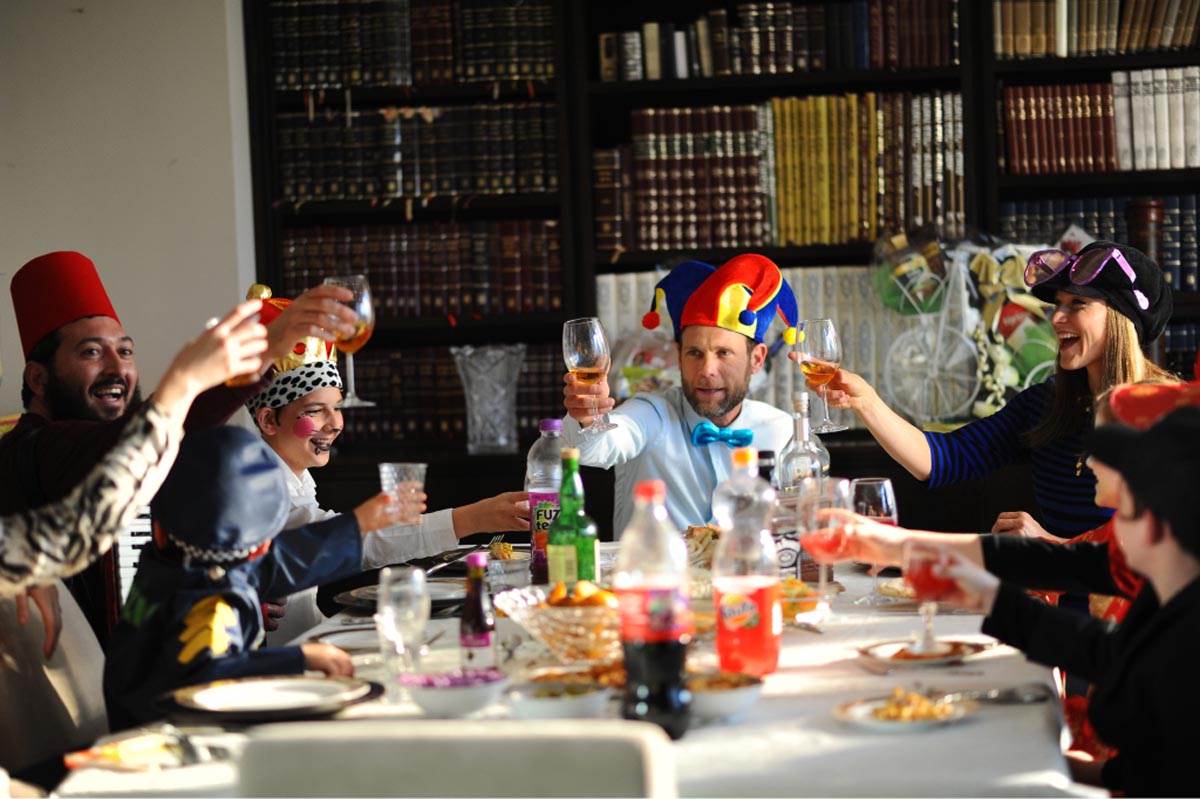
Who isn’t familiar with the ‘Purim’ custom – which has spread in most Jewish communities – to dress up on Purim?
Well, there are several reasons for this:
-
- ”And it was turned around”: Just as during Purim a miracle happened and the entire decree was ‘turned around’ from evil to good, from a plot of destruction to a day of victory, from distress to prosperity, and from mourning to joy, we behave ‘to invert our identity’ and dress up.
- Since God’s name is ‘hidden’ and ‘concealed’ in the Book of Esther, we dress up and hide our true faces.
- Remembering that ”Esther did not reveal her people or her birthplace” when she came before King Ahasuerus, we also ‘hide’ under a borrowed identity.
- As on this day there is a commandment to give ”gifts to the poor”, people dress up so that the poor can also ask for charity without feeling ashamed in front of people who recognize them.
Giving ”Purim money”
Like on Hanukkah, on Purim we also distribute ”Purim money” – some amount of money – to children during the day.
Since the Purim holiday stands out for its giving and sharing, and on this day we behave in the spirit of the principle that ”everyone who stretches out a hand – we give to him”, we therefore distribute money also to children.
It is advisable to encourage them to increase their charity and to allow them to give charity in practice, using the money they received.
Eating ‘Haman’s ears’
It is customary in Jewish communities to eat a special pastry in honor of Purim, called ‘Haman’s ear’, a delicacy made primarily from thin dough pockets filled with poppy seeds, and it has three corners.
There are several interesting explanations about the origin of this ‘tasty’ custom:
-
- The original name of the delicacy came from the Yiddish language: ”mon” – poppy seed, ”tash” – pocket. As it was customary to eat it on Purim, the word ”mon” became ”Haman”, and in Hebrew, they translated the ‘pocket’ to an ear due to its triangular and unique shape.
- It is possible that the triangular shape of this pastry is rooted in the image of the threatening triangular hat that was customary for military officers to wear in Eastern Europe, who were as cruel and evil as Haman the wicked.


