









The Book of Esther
The Book of Esther is one of the five scrolls included in the Tanakh, which tells the story of the miraculous salvation of the people of Israel during the time of Mordechai and Esther.
The reading of the Megillah on Purim is one of the ways in which we express our gratitude to the Creator of the world and our clear recognition that all the events of the Megillah are in fact a reflection of the ‘hidden finger of God’ that led ‘naturally’ to the cancellation of the harsh decree. Also, by reading the Megillah, we pass on the story of the miracle of Purim to future generations.
It’s interesting to note that the Book of Esther is almost the only book in the Tanakh in which the name of God does not appear – not even once!
The simple reason is that since the Megillah was copied and written in the book ‘Chronicles’ of the Persian kingdom, and at their time everyone worshipped idols – Mordechai and Esther did not want to write the name of God, fearing that the Persians might translate it into their language and replace it with the name of an idol.
But a study of the Megillah will reveal a surprising detail:
In fact, the ‘Purim miracle’ is not a miracle at all. The wicked Haman was not destroyed in a miraculous way, and the people of Shushan the capital were not visited by ten heavenly plagues. The story of the salvation of the children of Israel seemingly arose from a sequence of natural events related to politics in the palace courtyard and the whims of the omnipotent ruler Ahasuerus.
And this is precisely the message that comes from the Megillah:
A miracle is not only an event that ‘breaks’ the laws of nature. Also our blessed routine, the successes we attribute to our abilities or just good luck, healthy children we have, and the like – all these are but miracles! Only the naturalness in which they occur, deceives us into thinking that this is a self-evident routine.
We just need to ‘open our eyes’, and with a simple contemplation we will understand how much our lives are filled with miracles. Then we will also appreciate them accordingly, and even thank the Creator for the good and the wonderful He has bestowed upon us.
Therefore, the Megillah is called ”Megillat Esther” hinting that the story of the Purim miracle reveals to us (”Megillah” means revealing) the hidden name of God (”Esther” means hidden) in our daily routine.
What is the Megillah made of
A ‘kosher’ Esther Scroll must be written on parchment made from the skin of a kosher animal.
The Megillah is written by a ”Sofer STaM” (STaM is an acronym: Sifrei Torah, Tefillin, and Mezuzot) who uses black ink made according to an ancient ‘recipe’, and a special ‘pen’ made from a bird’s feather, called a ”kulmus”.
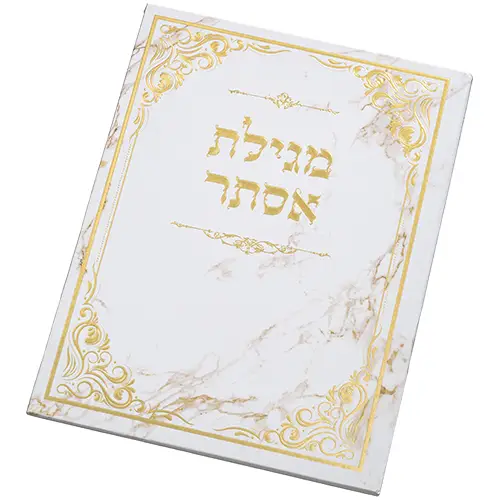
- Today, there are many booklets of the Esther Scroll, printed on regular paper, which serve for listening to the reading of the Megillah. There is no problem listening to the reading of the Megillah from these paper scrolls, as long as the reader reads specifically from a kosher parchment scroll. If for any reason you have not managed to hear a word from the reader, you can complete them from the printed scroll you have before these words are missed in the sequence of reading, for a few words it is still possible.
Where to read
There is a great preference and ‘preferred mitzvah’ to read the Megillah in the presence of a large congregation, in the synagogue.
- There is no obligation to read the Megillah specifically in the presence of a ”minyan” (ten men), so someone who cannot get to the synagogue, can read the Megillah at home, for himself or his household, from a kosher scroll.
When do we read?
In most cities in Israel and around the world, the Book of Esther is read twice during the Purim holiday: once at night, after the evening prayer (Arvit), and a second time during the day, during the morning prayer (Shacharit). There are places where it is read four times. See below on page 86 and onwards.
At night, the Megillah is read after ”Tse et hakokhavim” (when the stars come out) and the evening prayer, and it can be read throughout the night until dawn (”alot hashachar”).
During the day, the Megillah is read after the ”Amida” of the morning prayer, and it can be read from sunrise (”hanetz hachamah”) throughout the day, until sunset.
Who is obligated to listen?
Men, women, and also boys and girls are obligated to listen to the reading of the Megillah.
Although generally women are not obligated to fulfill commandments that are time-bound (like Tzitzit which are only required during the day and not at night, or the Sukkah which is only required on the Sukkot holiday, etc.), they are nevertheless obligated in the commandments of the Purim holiday for two main reasons:
-
- Because Queen Esther played a central role in the miracle of the Purim holiday and in the salvation of the Jewish people from annihilation.
- Because Haman’s decree was to ”annihilate, kill, and destroy all Jews, young and old, infants and women, in one day”, which includes women as well.
For this reason, we should also educate the little boys and girls to listen to the reading of the Megillah, but we should not bring small infants to the synagogue, as they might disrupt the congregation from hearing the reading in its entirety.


