










The blessings
The one who reads the Megillah opens the parchment scroll in front of him and blesses three blessings before the reading and one blessing after it, and during the blessings and the reading, he should intend that he is discharging the obligation on behalf of all the listeners.
- All present should respond ”Amen” after each blessing, and not say ”Baruch Hu Uvaruch Shemo” in the middle.
The three blessings before reading the Megillah are:
-
- ”Baruch… Asher Kidshanu Bemitzvotav Vetzivanu Al Mikra Megillah” (Blessed… who sanctifies us with His commandments and commanded us regarding reading the Megillah).
- ”Baruch… Sheasa Nissim La’avoteinu Bayamim Haheim Bazman Haze” (Blessed… who performed miracles for our ancestors in those days at this time).
- ”Baruch… Shehecheyanu Vekiyemanu Vehigi’anu Lazman Haze” (Blessed… who has kept us alive, sustained us, and brought us to this time).
- One should not speak from the beginning of the recitation of the blessings by the reader, until the end of the blessing after the reading of the Megillah.
During the reading
Since there are no verse markers and vowel points in the Megillah, the reading requires proficiency and expertise, and therefore, usually, in the synagogue, the Megillah is read by the ‘Ba’al Koreh’ (reader) who reads the ”Parashat Hashavua” (weekly Torah portion) from the Torah scroll.
There is an obligation to hear every word from the reading of the Megillah, and if we ‘missed’ even one word – we need to hear the entire Megillah again from the beginning. Therefore, when in the synagogue or any large place, one should maintain silence, and of course, one should not speak during the reading.
- Some have the custom to hold a kosher parchment Megillah with them during the reading and to read it quietly along with the ‘Ba’al Koreh’. In this way, even if they do not hear a few words, they can always ‘make them up’ by reading them themselves from the Megillah.
The Gragger and Haman
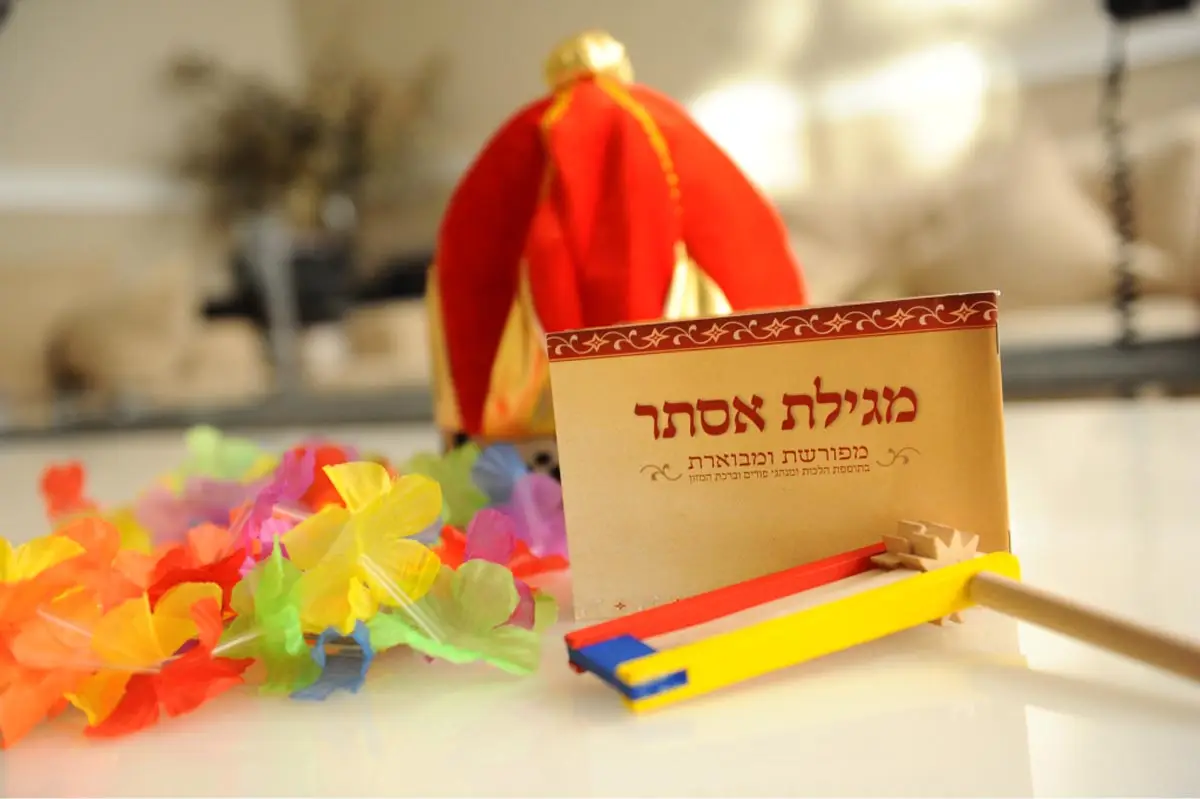
It is customary to stamp one’s feet, make noise with graggers (noisemakers), and more, every time Haman’s name is mentioned in the Megillah (the Book of Esther) with some sort of descriptor, such as: Haman son of Hammedatha the Agagite, this wicked Haman, and so forth.
- As it is required to hear every word, the reader must pause the reading and wait until the noise has ended. Adults should ensure that children do not make excessive noise, and do not disrupt the proper course of the Megillah reading.
Why do we ‘play’ with a gragger on Purim, and a dreidel on Hanukkah?
You will find the answer on page 39.
Reading Verses Aloud
It is customary for the public to ‘participate’ occasionally in the reading of the Megillah, and recite several verses from it out loud:
-
- In Chapter 2, Verse 5: ”There was a Jewish man in Shushan the capital, whose name was Mordecai…”
- In Chapter 8, Verse 15: ”Mordecai went out from the presence of the king…and the city of Shushan was joyful and glad.”
- In Chapter 8, Verse 16: ”For the Jews, there was light, happiness, joy, and honor.”
- In Chapter 10, Verse 3:”For Mordecai the Jew…and he sought the welfare of all his people.”
Before each of these verses, the reader pauses, the public recites the verse out loud, and then the reader repeats the verse that everyone has said, reads it alone out loud from the Megillah, and continues on.
The Ten Sons of Haman
Towards the end of the Megillah reading, we read the names of Haman’s ten sons in one breath, from the words ”five hundred men” (Chapter 9, Verse 6) to just after the word ”ten sons of Haman.”
Here too, it is customary for the reader to pause before the verses, the public says the names of Haman’s ten sons aloud in one breath, and then the reader repeats this aloud also in one breath.
- The custom of saying the names of Haman’s ten sons in one breath is just that, a custom, and therefore even if the reader breaks in the middle and takes a ‘deep breath’ – everyone still fulfills their obligation of the reading.
Changing Verses
During the Megillah reading, there are two places where we repeat a word twice, with a slight change:
-
- In Chapter 8, Verse 11: The first time we read ”to destroy, to kill,” and immediately repeat: ”and to kill (with the addition of the letter vav) and to destroy.”
- In Chapter 9, Verse 2: The first time we read ”and no one could stand before them,” and immediately repeat: ”and no one could stand in their presence (with ‘lamed’ instead of ‘bet’).”
Moving the Megillah
During the Megillah reading, we mention the ”letter” – that is, the Scroll of Esther – which Mordecai and Esther sent to all the Jews to remind them to observe the commandments of the Purim holiday, twice.
In these two places, those who read or hear the reading from a parchment scroll – it is customary to lightly sway the Megillah during the reading:
-
- In Chapter 9, Verse 26: When saying ”(according to all the words of) this letter.”
- In Chapter 9, verse 29: with the recitation of ”to uphold the Purim scroll, this second one”.
After the reading
At the end of the reading of the Megillah, we say a special blessing: ”Blessed are You… who increases our disputes, who judges our disputes, who avenges our disputes, who frees us from our oppressors, who repays our enemies for us. Blessed are You, Lord, who relieves His people Israel from all their trouble, the God who saves”.
Afterwards, we continue and say the passage: ”The rose of Jacob rejoiced and was glad… Cursed is Haman… Blessed is Mordecai… and also Charvona should be remembered for the good”.


