









Introduction
- It is preferable not to eat in the morning of the festival until after hearing the Megillah, but a weak person may taste fruits, drinks, and the like.
Morning Prayer (Shacharit)
We pray the morning prayer as usual: we wrap ourselves in a tallit and put on tefillin, we start with the opening sections, continue with ”give thanks” and ”verses of praise” and read the ”Shema and its blessings”.
In the ”Amidah” prayer, we add the passage ”for the miracles” after the blessing of ”we thank”.
In the morning prayer we do not say ”Hallel” on one hand, but on the other hand we do not say the ”Tachanun” sections.
Why don’t we say ”Hallel” on Purim?
- Because the sages determined not to say ”Hallel” for a miracle that happened outside the land, after we had already entered the Land of Israel in the time of Joshua bin Nun.
- Because the reading of the Megillah serves as a sort of ‘substitute’ for the ”Hallel” of the Purim holiday.
- Because even after the Purim miracle, the Jews were under the rule of Ahasuerus and were not completely liberated to serve God, and the saying of the ”Hallel” mainly symbolizes our absolute servitude to the Creator of the world.
Torah Reading
After the ”Amidah” prayer, the cantor says ”half Kaddish”, they open the Holy Ark and take out one Torah scroll.
Three men ascend for the Torah reading, and they read a section from the portion of ”Beshalach” dealing with Amalek’s war with the people of Israel after they left Egypt.
- Those who read the Torah in Ashkenazi pronunciation, say twice the word ”remember” in the verse ”You shall blot out the remembrance of Amalek”. The first time they read ”remember” (in Segol) and the second time – ”remember” (in Tzere).
After reading the Torah, we still remain with the tallit and tefillin and approach to read the Megillah.
We bless three blessings as yesterday, and in the blessing of ”Who has kept us alive”, we should think that we are ‘discharging our obligation’ also for the other commandments of the day: sending portions, gifts to the poor, and the Purim meal.
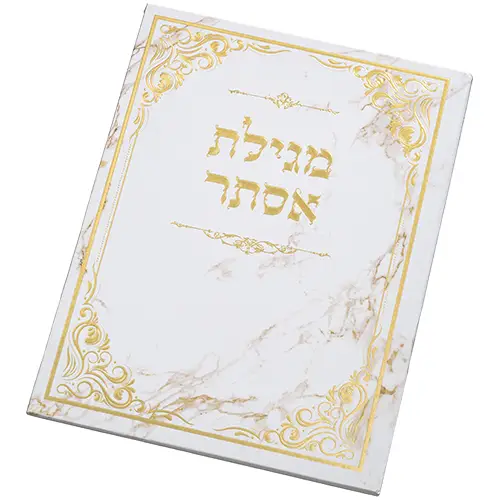
All the laws of the Megillah reading on Purim Day – the order of reading, who reads, how it is read, which verses the congregation says aloud, when to make noise at ”Ha-man”, and more – are exactly like the reading on Purim night. See in detail above, page 75 and onwards.
After the Megillah reading, they bless ”Harav et riveinu” (He who has fought our fight), and recite ”Shoshanat Yaakov” (The rose of Jacob). They continue the prayer with ”Ashrei” (Happy) and ”Uva Letzion” (and when the redeemer comes to Zion), the prayer leader says ”Kaddish Shalem” (Whole Kaddish), they return the Torah scroll to the Ark, and conclude the prayer as usual.
Mincha prayer
It is good to pray the Mincha prayer before sitting down to eat the Purim meal, in order not to create a situation where the meal lasts, and due to the abundance of wine drunk, one might miss the prayer time.
- Remember to say ”Al Hanisim” (On the miracles) in the ”Amidah” prayer.
Sending of portions
On the Purim holiday, we emphasize Jewish unity and the warm connection between one person and his neighbor and between one family and another. One of the mitzvot of the Purim holiday is to send a friend at least one ‘package’ containing two types of ‘portions’ of food or drink. For example: a bottle of wine and a pack of cookies.
-
- From an ‘official’ perspective, the mitzvah is to ‘send portions’ to one friend, but anyone who increases ‘sending portions’ to as many friends as possible – it is praiseworthy!
- Both men and women are obliged in this mitzvah. A man should send to his friend, and a woman – to her friend.
- We do not fulfill the obligation of the mitzvah by sending clothes, books, or jewelry, but with food items only.
- We should send food items that are ready to eat or drink immediately, without the need to cook, fry or bake them. For example: cooked meat, poultry and fish, casseroles and baked cakes, and of course – fruits, sweets, wine, and other beverages.
- You can include in the ‘package’ two pieces of the same type of food, such as: two different portions of meat, chicken and the like. Be careful that the ‘package’ should be respectable (and not too simple and dismissive), at least in the eyes of the recipient.
- Some have the custom to send the ‘package’ by a messenger (a son, a brother, a friend and the like).
Gifts to the poor
Another mitzvah that deepens the sense of belonging and responsibility among all the people, is: to give charity (money or food) to at least two poor people on the Purim holiday.
-
- There is no fixed amount for this mitzvah, and you can give as much as you want.
- If there are no poor people in the area, or if it is hard for a person to leave his home and the like, you can set aside the amount of money and give it to the poor in the future, as soon as possible.
- It is possible to give charity via the Internet to associations and organizations that distribute the money to the poor and needy on Purim day itself, thereby fulfilling the mitzvah.
- On Purim it is customary not to ‘scrutinize’ and ‘examine the fringes’ of those who ask for charity, but to behave in the spirit of the Purim principle: ג€Kol ha’poshet yad, notnim loג€ (whoever stretches out his hand, give him).
- Both men and women are obliged in this mitzvah, and a man can give charity to a poor woman and likewise a woman to a poor man.


